
How to Size a Commercial Range for Peak Restaurant Service
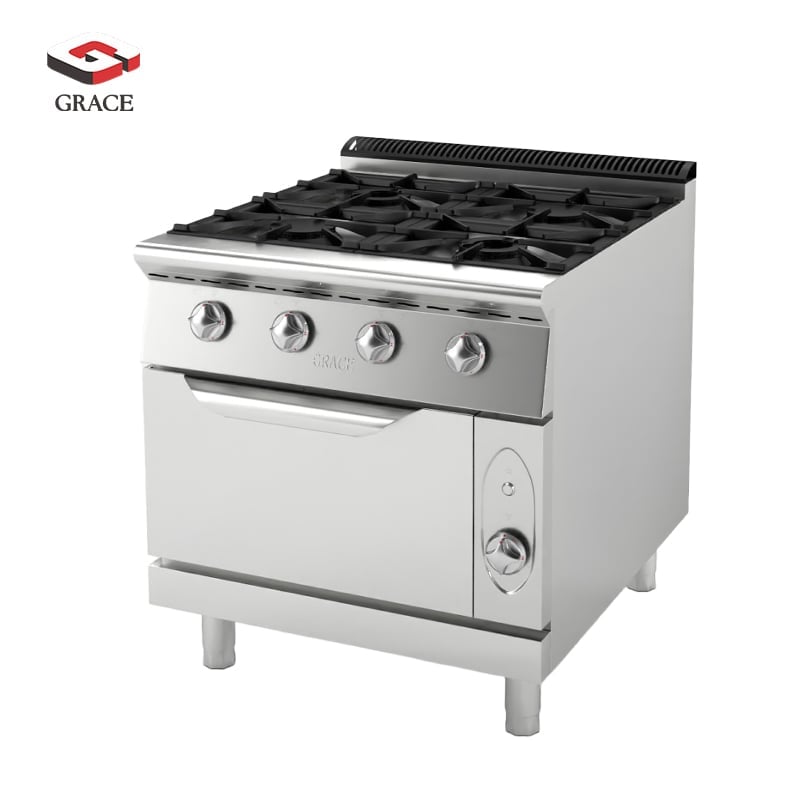
Size a commercial range from the pans that must be on the heat at the same time during your busiest service window. Record how long each task occupies a burner, including loading and changeover, then test whether the proposed top can accommodate the actual cookware.
A restaurant opening with a four-burner range and a hotel considering a six-burner range need the same evidence: a short production timetable. This guide shows a worked example and how to use it when comparing GRACE equipment.
Start with one busy service window
Choose a period that causes a real constraint, such as the first 30 minutes of lunch or a banquet dispatch. Record the tasks carried out on the range during that period. Include equipment that stays occupied even when the cook is working somewhere else.
- Fixed use: pots held on a position for most of the service window.
- Repeated batches: sauté, boiling or other pan work that frees a position between batches.
- Changeover: removing a pan, loading the next one and returning the station to a usable condition.
- Cookware fit: pan diameter, handle orientation and the space staff need to handle the pans.
Keep oven work on a separate line. A unit can have enough top positions while its oven is occupied by a different batch. If the equipment terminology is unclear, see the guide to burner counts, range tops and oven bases.
A worked 30-minute burner plan
Illustrative example: these times describe a hypothetical menu and working method. They are planning inputs, not measured cooking performance for a GRACE model.
Assume two stock pots occupy two burner positions throughout a 30-minute window. In the same window, the team must complete eight pan batches. Each batch needs 12 minutes on the heat and two minutes of changeover, occupying one position for 14 minutes.
| Tarea | Calculation | Position time |
|---|---|---|
| Two stock pots | 2 positions × 30 minutes | 60 burner-minutes |
| Eight pan batches | 8 batches × (12 + 2) minutes | 112 burner-minutes |
| Combined demand | 60 + 112 | 172 burner-minutes |
A burner-minute is one position occupied for one minute. Dividing the combined demand by the service window gives 172 ÷ 30 = 5.73 positions on average. That is an initial capacity check; the sequence and pan fit still need testing.
| Proposed top | Time remaining after stock pots | Result for repeated pan work |
|---|---|---|
| Four burners | (4 × 30) − 60 = 60 burner-minutes | Less than the 112 required. Revise the sequence, move a task or consider more suitable equipment. |
| Six burners | (6 × 30) − 60 = 120 burner-minutes | The arithmetic accommodates 112, with only 8 burner-minutes unallocated. Check timing, cookware and service variation. |
One possible six-position sequence keeps the stock pots on positions 1 and 2. Positions 3–6 run four batches from minute 0 to 14 and the next four from minute 14 to 28. The remaining two minutes on those four positions are a small scheduling allowance; they do not establish a reliable operational reserve.
If orders arrive later, pans need longer to recover heat or staff cannot load four positions together, that sequence changes. Run the exercise again using a timed menu trial before confirming the equipment.
Compare the GRACE footprint as well as the burner count
The GRACE product listings below provide starting points for a four- versus six-burner comparison. Their listed power figures do not replace the component breakdown or a menu trial.
| Campo | GR-901 | GR-961 |
|---|---|---|
| Configuración | Four-burner gas range with gas oven | Six-burner gas range with gas oven |
| Listed dimensions | 800 × 900 × 850 + 70 mm | 1,200 × 900 × 850 + 70 mm |
| Listed power | 27 kW | 38 kW |
| Model page | GR-901 specification | GR-961 specification |
The published width difference is 400 mm. Put both alternatives on the layout and check their relationship to preparation, landing space and the pass. Request the current model drawing to confirm height notation, burner spacing, oven access and required installation clearances.
Ask for power allocated to the top and oven, the proposed gas configuration and the relevant connection information. A listed kW figure alone does not tell you how many portions a specific menu will produce.
Use this worksheet for your menu trial
- Record each dish or process and its required quantity during the selected window.
- Measure batch size and total position-occupancy time using the intended pans.
- Mark tasks that run simultaneously and tasks that can be completed earlier.
- Place the largest pans on the proposed top arrangement and review handling with the operating team.
- Compare the resulting sequence with the proposed model and the site’s confirmed utility and ventilation provisions.
If the timetable fails, consider the reason before adding burners. A task could be better suited to another appliance, an earlier preparation period or a different batch size. Review the effect on food quality, staff workload and the rest of the equipment schedule.
Questions to resolve before ordering
How many burners does a restaurant need?
Use the busiest operating window, timed pan tasks and cookware fit to compare proposals. Seat count helps describe the operation, but the actual cooking sequence determines which positions are occupied.
Does a six-burner model solve every peak-service problem?
Check the complete line. Preparation, oven occupancy, landing space, staffing and the pass can constrain service even when positions are available on the top.
What information should I send with an inquiry?
Send the menu, peak-service window, batch quantities, pan sizes and any equipment list or layout you already have. If you are still developing the project, describe the intended operation and the site information available so the open decisions can be identified.
Plan the cooking line with GRACE. Share your equipment list, layout or production brief and the decisions you need to resolve.