
How to Make Lemon and Sugar Crêpes on a Commercial Crêpe Maker

Serve thin French-style crêpes with golden freckles, tender folded edges and a simple lemon-and-sugar finish. This recipe gives a café team a measured batter and a repeatable plate trial for cooking to order.
Lemon and sugar crêpes with delicate folded layers. AI illustration.
Ingredients for 24 crêpes
Target yield: 24 crêpes, each around 28–30 cm across, from 65 g batter per piece. The batter totals 1,600 g. At the trial dose, 24 pieces use 1,560 g, leaving 40 g for transfer and ladle losses. Record the actual yield when you settle the dose and diameter on your plate.
| Component | Ingredient | Batch weight |
|---|---|---|
| Batter | Plain flour | 400 g |
| Whole milk | 800 g | |
| Pasteurised liquid whole egg, unsweetened | 240 g | |
| Unsalted butter, melted and cooled slightly | 100 g | |
| Caster sugar | 40 g | |
| Fine salt | 8 g | |
| Vanilla extract | 12 g | |
| Total batter | 1,600 g | |
| Acabado | Fresh lemon juice, strained | 120 g |
| Caster sugar | 120 g |
For each crêpe, start with 5 g lemon juice and 5 g finishing sugar. If the plate instructions require release oil, prepare up to 20 g neutral oil separately for light wiping. The amount used depends on the plate’s finish and preparation. Contains wheat, milk and egg.
Have a scale, mixing bowl, whisk, sieve, covered batter jug, ladle, suitable spreader, crêpe spatula and surface-temperature probe ready. Keep batter tools separate from cooked-food serving tools.
Choose a single or double plate
El GRACE GR-410 single-plate electric crêpe maker suits a small café or staffed dessert counter learning one cooking cycle at a time. Its listed 400 mm plate leaves room around the target 28–30 cm crêpe.
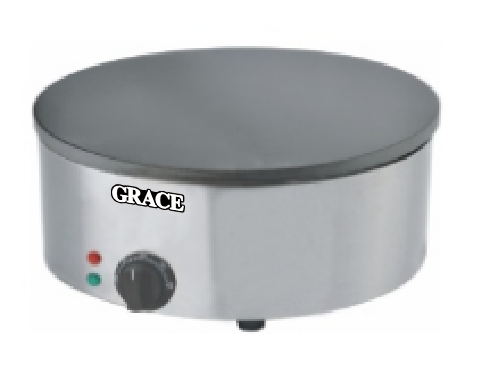
| Especificación | GR-410 |
|---|---|
| Cooking format | One circular plate |
| Listed plate diameter | 400 mm |
| Listed supply and power | 220 V, 2.2 kW |
| Overall dimensions | 400 × 400 × 160 mm |
El GRA-2 double-plate electric crêpe maker is another option when a trained team needs two cooking positions. It is listed at 220 V and 3 kW per plate, or 6 kW combined. Compare the plate layout in the GRACE main catalog. Verify the exact unit’s nameplate, circuit, plate finish and first-use preparation before operation. Establish the cooking cycle on each plate you use.
Mix and rest the batter
- Mix a smooth base. Stir the flour, batter sugar and salt together. Whisk the milk and egg in another jug. Add about half the liquid to the dry ingredients and whisk until smooth, then gradually add the rest. Stir in the melted butter and vanilla. Pass through a sieve if lumps remain.
- Rest covered and cold. Refrigerate the batter for about one hour to hydrate the flour. Keep the fridge at 5°C or below, following the UK food-business chilling guidance. Label the batch and keep reserve batter cold during service, bringing out a small working jug at a time.
- Prepare for portioning. Stir gently before filling the working jug. Weigh the filled ladle to identify the mark for 65 g. The batter should pour in a smooth stream and spread into a thin layer. For background on resting and cooking thin crêpes, see King Arthur Baking’s Parisian-style crêpes.
Prepare the GR-410 and run the plate trial
- Check the plate before switching on. Make sure the plate is clean and dry and the controls are clear. Complete any first-use conditioning or seasoning specified for the supplied plate. Set out a clean, heat-resistant place for the spreader and spatula.
- Preheat and measure. Begin the trial around 200°C (392°F) if the dial has temperature markings. With an appropriate contact surface probe, check the centre and outer working area. Allow the plate to stabilise and note the dial position. If the dial is uncalibrated, adjust it gradually against the measured surface temperature.
- Spread one measured portion. If the plate instructions call for release oil, wipe on a very thin film. Pour 65 g batter near the centre and spread promptly with light circular passes. Aim for a round, even 28–30 cm sheet without pushing the edge off the working area.
- Check the first side from about 60 seconds. Look for a set surface, a dry lifting edge and golden freckles underneath. Slide the spatula around the edge and turn once the crêpe supports itself. Start checking the second side after about 20 seconds and continue until it is fully set with no wet batter. Follow your kitchen’s approved cooking process for the milk-and-egg batter.
- Finish to order. Move the cooked crêpe to a clean plate. Add 5 g lemon juice and 5 g sugar across the surface, then fold in half and half again. Serve promptly to keep the edges tender.
- Repeat and check recovery. After the pilot, cook several consecutive pieces with the same dose. Record the diameter, colour, first-side and second-side times, and plate recovery between pours. If colour fades over successive pieces, allow more recovery and recheck the surface temperature.
The 200°C target, 65 g dose and first-check times are starting points for this recipe. Confirm them on the installed GR-410 before setting staff timers. Include the pilot pieces in your yield record.
Troubleshooting during service
| Problem | What to adjust |
|---|---|
| The crêpe tears on turning | Let the first side set more fully, loosen the edge and slide the spatula farther underneath. Check the same ladle dose and diameter before changing the batter. |
| Batter sets before it spreads | Check the surface temperature and reduce it slightly for the next piece. Pour and spread in one smooth sequence. |
| Thick or rubbery crêpes | Recheck portion weight, resting and spread diameter. If the rested batter still spreads poorly, test a small weighed milk adjustment and record the revised batch weight and yield. |
| Pale, greasy patches | Use less release oil, give the plate time to recover and check the working area’s temperature before pouring again. |
Clean the station after service
Switch the GR-410 off and follow its instructions for cooling, power isolation and cleaning the plate surface. Remove cooked residue with the approved tools and pads for that finish. Keep the electrical housing and controls dry. Wash and sanitise the batter and serving tools separately. Recondition the plate as directed, then leave it clean and dry for the next shift.