
Rosemary Focaccia Recipe for a Commercial Convection Oven
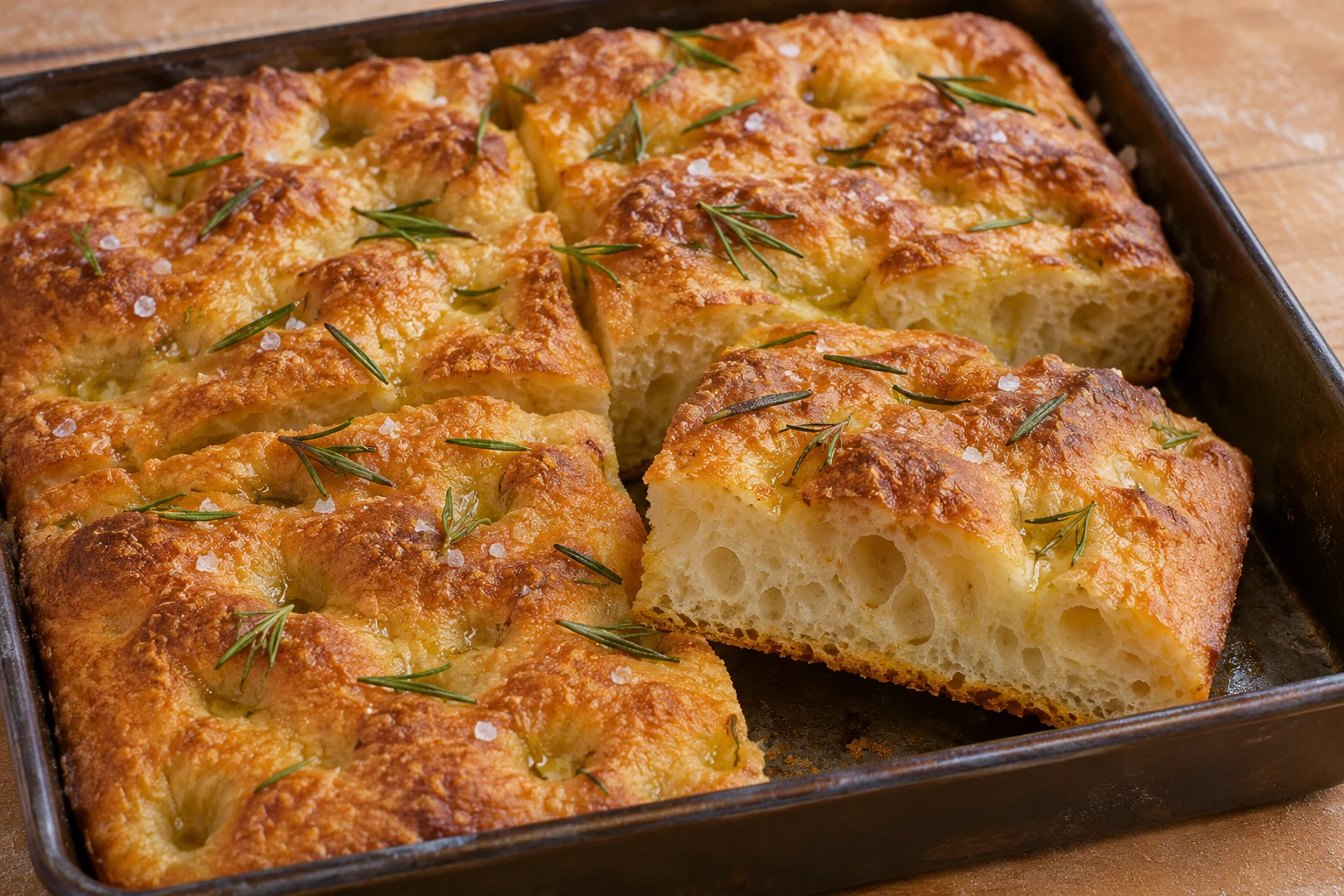
Bake two pans of Italian rosemary focaccia and cut them into 18 portions for a café counter or sandwich station. Aim for a dimpled golden top, an airy crumb and a crisp base.
Rosemary focaccia with flaky salt. AI-generated illustration.
Ingredients for two pans
Use two 23 × 23 cm (9 × 9 in) dark metal baking pans. The dough weighs approximately 1,358 g before handling losses. Divide it into two portions of about 679 g and cut each baked slab into nine squares.
| Ingredient | Where it goes | Weight |
|---|---|---|
| All-purpose flour | Dough | 720 g |
| Water | Dough | 568 g |
| Fine salt | Dough | 18 g |
| Granulated sugar | Dough | 10 g |
| Instant yeast | Dough | 6 g |
| Extra-virgin olive oil | Dough | 36 g |
| Extra-virgin olive oil | Pans and topping | 52 g |
| Fresh rosemary leaves | Topping | 4 g |
| Flaky sea salt | Topping | 4 g |
The dough is a two-pan adaptation of the King Arthur Test Kitchen focaccia formula. The rosemary and finishing salt quantities are starting points for this batch.
Mix, fold and proof
- Mix the dough. Combine the flour, fine salt, sugar and yeast in a bowl. Add the water and the 36 g of olive oil. Mix until no dry flour remains. Use warm water to aim for a dough temperature of 28–30 °C after mixing. Cover and rest for 15 minutes.
- Build strength with folds. Wet your hand, lift a section of dough from the edge of the bowl and fold it toward the middle. Work around the bowl until the dough tightens. Do four sets of folds, 15 minutes apart, keeping the bowl covered between sets.
- Let the dough rise in bulk. After the last fold, cover it and leave it until puffy and close to double its original volume. Use about an hour as a planning allowance in a warm room. Judge the dough by its rise and bubbles.
- Divide and proof in the pans. Coat the base and sides of each pan with 18 g of the reserved oil. Transfer about 679 g of dough to each pan with a scraper. Let the dough relax if it springs back. Cover and proof until it spreads toward the corners, shows surface bubbles and jiggles when you nudge the pan. Plan for about 60 to 90 minutes and adjust to the dough.
- Dimple and top just before baking. Oil your fingertips and press straight down at regular intervals. Spread 8 g oil across each pan and scatter 2 g rosemary and 2 g flaky salt over each. Toss the rosemary in some of the topping oil so the leaves stay lightly coated.
Bake on the GRACE GR-5DH
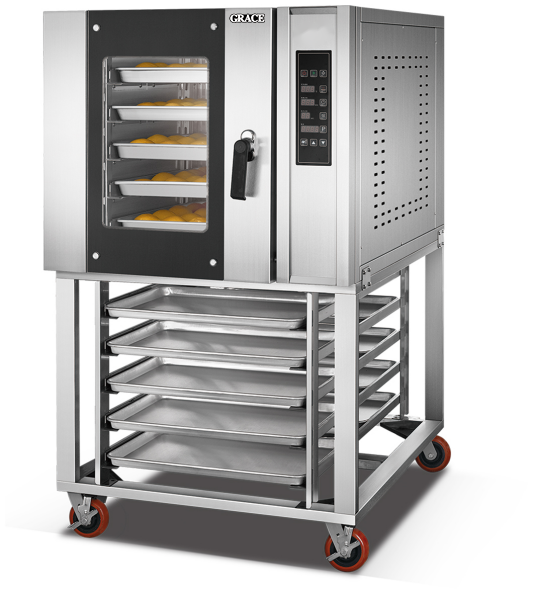
| Especificación | GR-5DH |
|---|---|
| Heating | Electric convection |
| Capacidad | Five 400 × 600 mm tray positions |
| Supply and rated power | 380 V, 50 Hz · 7.5 kW |
| Listed temperature range | 30–400 °C |
- Preheat. Use the installed oven’s instructions to select the convection bake mode and confirm the initial setpoint for this pan and dough weight. Wait for the oven to stabilize before loading. The test kitchen’s recipe uses 246 °C (475 °F) in a conventional oven. Use that as a reference when agreeing on a convection starting point with your equipment team.
- Test one pan first. Centre the pan on a rack or tray supported as directed by the oven manual. Keep the airflow path clear. Log the setpoint, rack position and elapsed bake time. Compare the colour at the front and back. Check that the underside is golden, the centre is set and the edges release cleanly.
- Check two pans at service load. Use separate rack positions if the first pan bakes evenly. Leave space for air to circulate and compare the colour and set of both slabs. Write the confirmed time, setpoint and rack positions on the station card before repeating the batch. Test separately if you plan to use more rack positions.
- Cool and portion. Lift the bread out of the pans and cool it on a rack so steam can escape from the base. Cut each slab in a three-by-three grid once the crumb has set. Check the centre cut before serving or packing.
- Clean after service. Follow the oven manual’s shutdown and cool-down steps. Once safe to handle, remove trays and loose crumbs, then clean the cavity and racks with the method specified for the oven. Keep water and cleaner away from the controls.
Record the setpoint, bake time, rack positions, pan type and the number of portions that pass the bake check. The formula yields 18 portions. Confirm the oven settings and repeatability with a batch on your installed GR-5DH.
Common problems and what to change
| Result | Change for the next test |
|---|---|
| Dense centre with few air pockets | Wait for more visible bubbles and movement during the pan proof. Handle the dough gently after the bulk rise. |
| Dark top with a pale or gummy base | Verify the dough weight and pan type, then test a lower approved rack position or a lower setpoint with a longer bake. Change one variable at a time. |
| Top and bottom pans colour differently | Confirm the rack spacing and pan placement. Repeat the two-pan trial with a different approved rack arrangement before increasing the load. |
| Base softens after baking | Take the slab out of the pan and cool it on a rack. Pack it after it has stopped steaming. |
For an oven recommendation, share your pan dimensions, portions per service and available electrical supply with GRACE. Browse GRACE bakery equipment