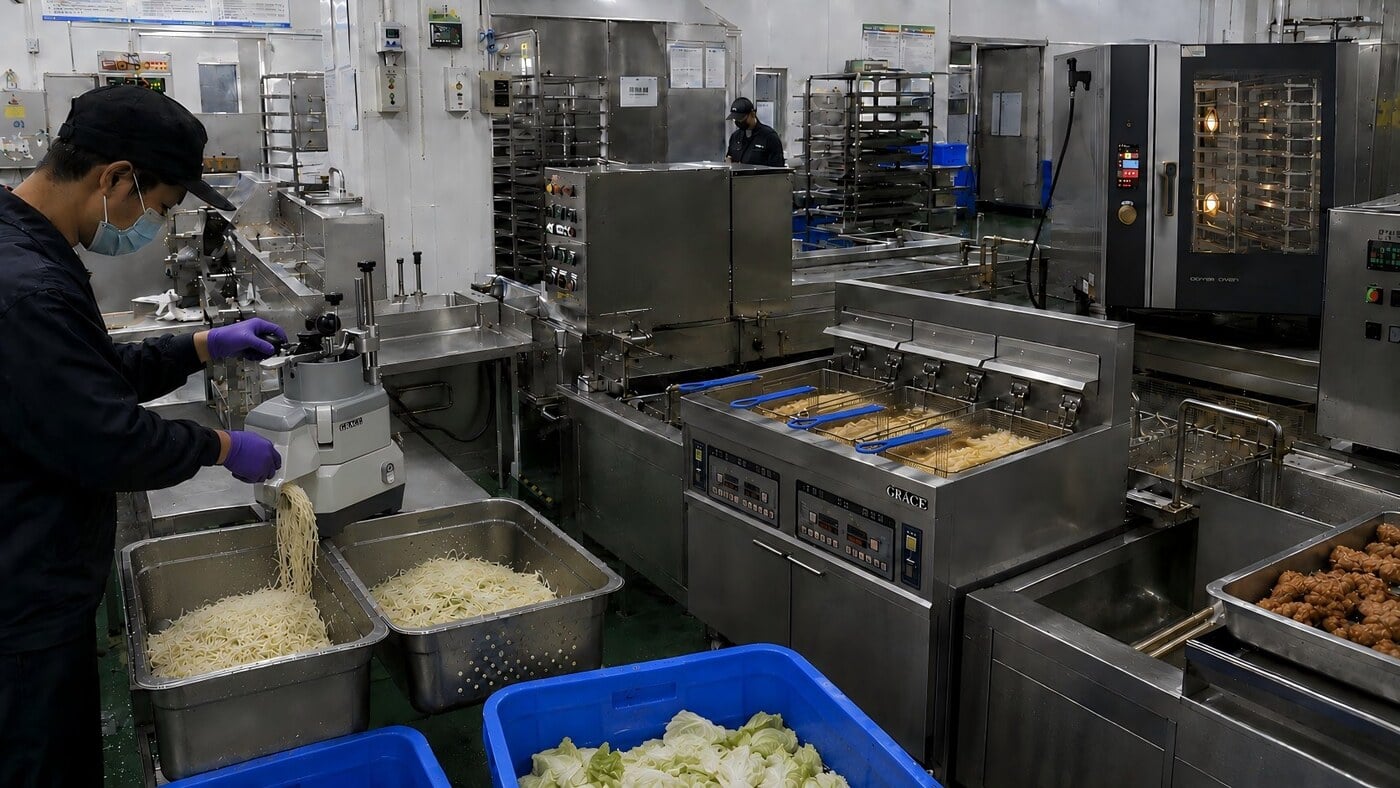
A working central kitchen production line — vegetable processing, bulk cooking, GRACE fryer bank and combi oven, all under one quality standard.
A central kitchen is one of the highest-stake builds in food service. It feeds a supermarket chain's prepared-food aisles, a restaurant chain's outlets, a food court's daily covers, an airline's catering, a school district's lunches or a city's hospital meals. If the central kitchen falls short on output, food safety, or hygienic flow, the entire downstream operation falls with it. Yet central kitchens are also the projects most often sourced badly — equipment lists assembled piece by piece, with no single party owning the production-capacity calculation, the cook-chill backbone, or the HACCP-compliant zoning that holds the whole facility together.
This article walks through how GRACE delivers a central kitchen as a single turnkey project: our 6-phase process from production-capacity sizing to commissioning, the real central kitchens we have built across 130+ countries, and what an operator can expect at each stage.
2006Founded
22,000㎡Manufacturing facility
3,000+Projects completed
130+Countries served
Key Takeaways
GRACE delivers central kitchens as turnkey projects — one contract covering production-capacity design, manufacturing, cook-chill backbone, installation and after-sales.
Every project starts with output-throughput calculation: how many meals per day, peak cooked output per hour, and the matching cook-chill capacity that holds it.
Our 6-phase process — consultation, design, specification, manufacturing, logistics, installation & after-sales — typically runs 12–16 weeks from design sign-off to delivery.
HACCP-compliant zoning is designed in from Phase 2: raw / clean / cooked / dispatch zones with crossing-flow prevention.
Project record includes supermarket chains (Carrefour), restaurant groups, food-court operators, institutional caterers and food-processing facilities across 130+ countries.
A central kitchen is not a scaled-up restaurant kitchen. It is a food-production facility, with the same engineering discipline as any manufacturing plant: throughput is calculated; flow is designed; food safety is structurally enforced through zone separation, not just through procedure. Yet many central kitchens are still built by stacking restaurant-grade equipment into a bigger room — a method that fails the moment volume hits design capacity.
What an operator actually needs is a contractor who can size the facility to its real daily output, design the raw-to-cooked-to-dispatch flow with no crossing zones, specify cook-chill equipment that matches peak cooked volume, manufacture all of it to one quality standard, and commission the whole thing as a working system. This is what a turnkey central kitchen project is — and what GRACE has been doing for over twenty years, on projects from regional supermarket chains to multi-country food-court operators.
The GRACE 6-Phase Central Kitchen Project Process
Every central kitchen we build follows the same six phases. Sequence and discipline are how throughput targets are actually hit — and how an operator knows, at every stage, exactly where the project stands.
PHASE 1
Consultation & Needs Analysis
Typical duration: 5–10 days
The project starts with the operating model, not the equipment list. We need to understand: what end outlets the central kitchen will supply (own restaurants, supermarket stores, food courts, institutional sites), expected meals per day at launch and at three-year scale, menu mix (hot meals, cold-chain ready meals, par-baked, frozen), distribution radius, the destination country's HACCP and food-safety regulations, and the available building footprint.
Operating-model workshop with the project owner and operations team
Meals-per-day calculation at launch capacity and full-scale capacity
Distribution radius and cold-chain mode (chilled / frozen / hot-hold)
HACCP framework and destination-country food-safety regulations
Output: a written production-capacity brief signed off before design starts
PHASE 2
Capacity Design & HACCP Zoning
Typical duration: 10–18 days
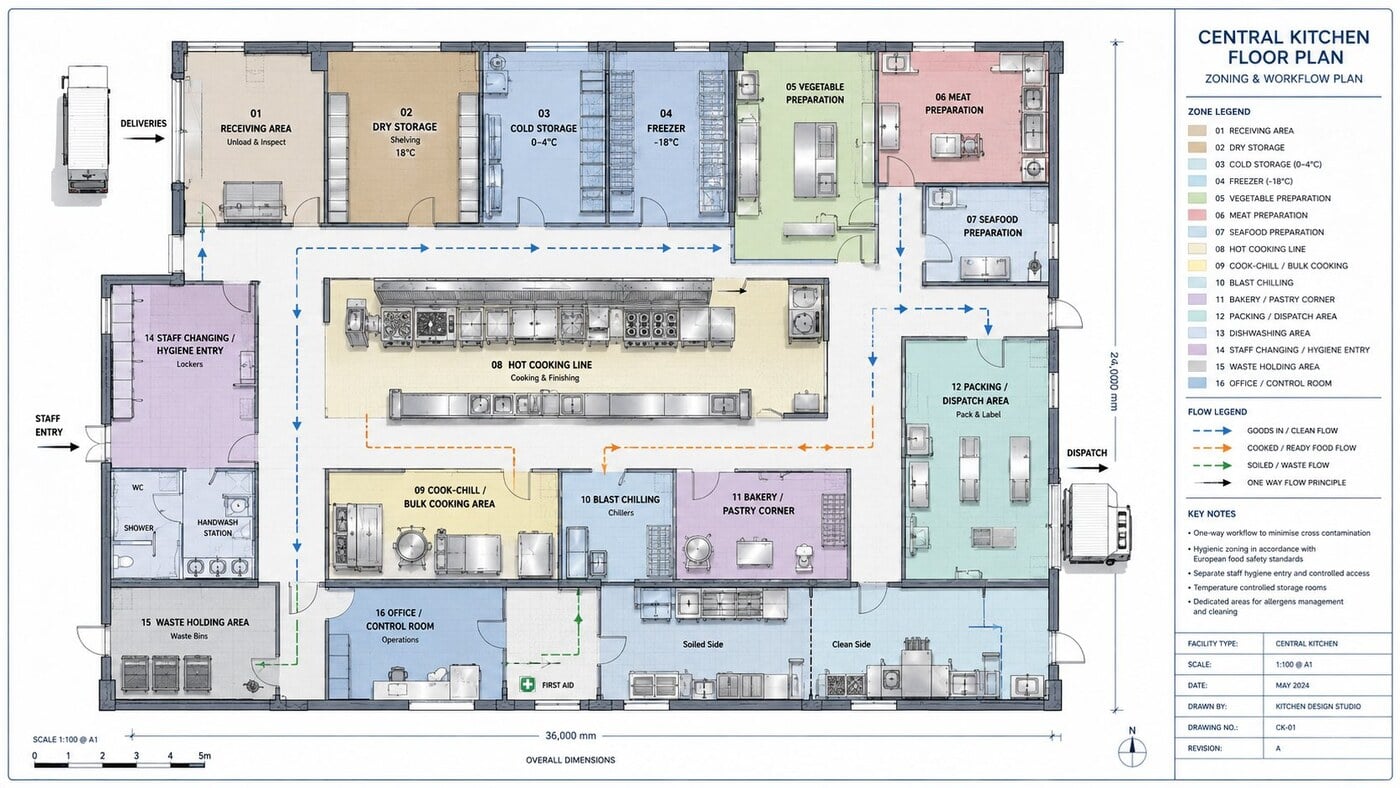
From the production-capacity brief, our engineering team designs the facility layout in CAD and 3D — sized to the throughput target, zoned for HACCP compliance, and engineered around the cook-chill backbone. Crucially, this phase produces the calculations that bind the design together: peak cooked output per hour, matched blast-chill capacity, cold-storage volume by SKU rotation, and dispatch capacity by distribution shift.
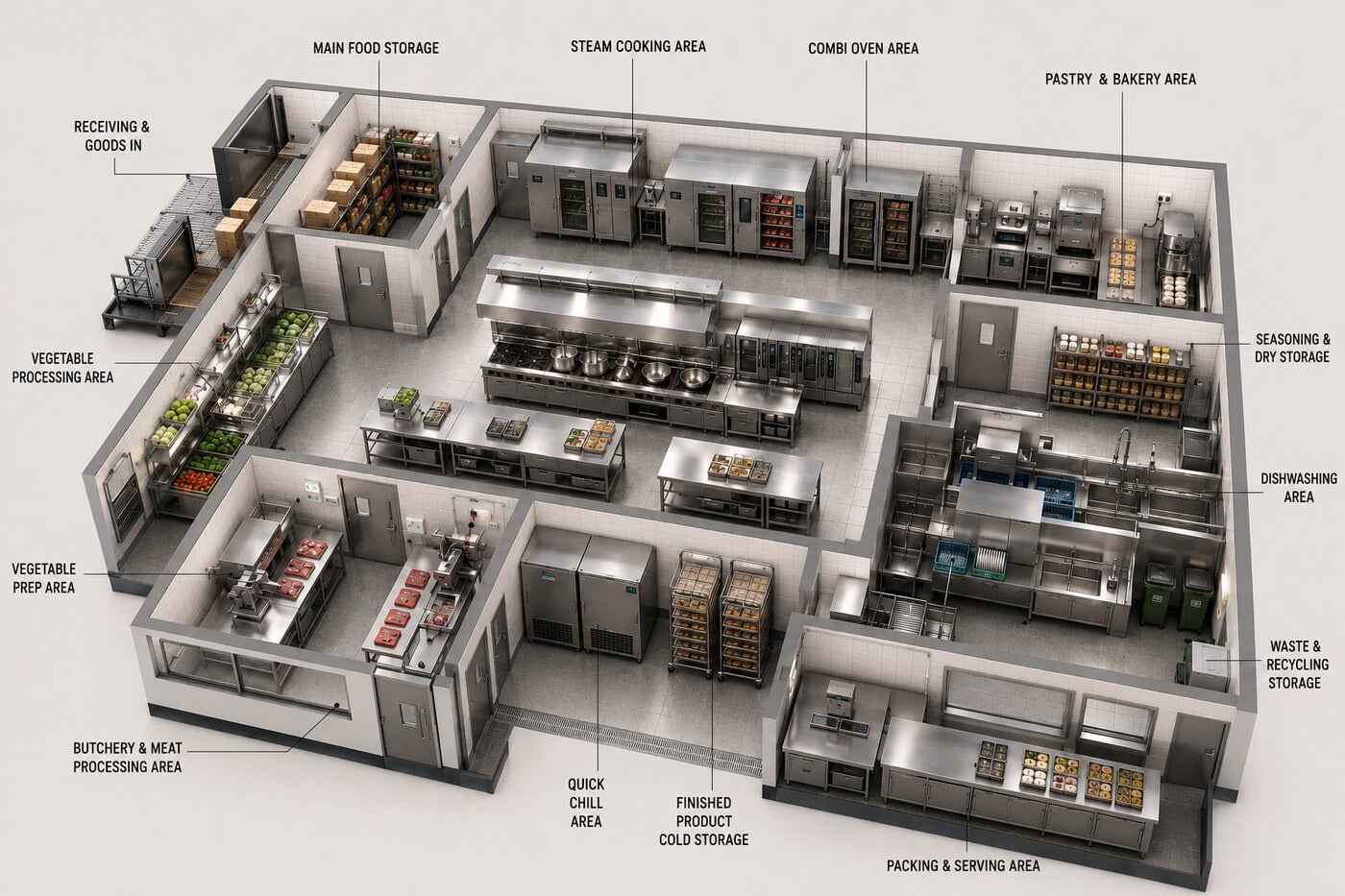
Central kitchen floor plan — 16 functional zones, HACCP-compliant one-way workflow (clean blue / cooked orange / waste green flows), receiving to dispatch.3D central kitchen rendering — every functional zone visualised in detail, from receiving and storage through cook-chill to packing and dispatch.
Throughput-driven layout — sized to meals-per-day target, not by floor area
Cook-chill capacity calculation: blast-chiller sized to peak cooked output
Workflow direction designed for no crossing flow between raw and cooked
3D renderings of the production line and zones for operator visualisation
Design delivered at no charge as part of the proposal
PHASE 3
Equipment Specification & Quotation
Typical duration: 7–14 days
With the layout signed off, every item is specified against the throughput it must hit — tilting braising pan capacity matched to batch size, steam kettle volume to soup output, combi oven racks to roasting peak, blast-chiller tonnage to peak cooked load — and a complete itemised quotation is issued. Every line is transparent: equipment, specification, throughput contribution, position on the drawing, and price.
Itemised quotation cross-referenced to the production-capacity calculation
Specifications matched to destination voltage, gas type and certifications
Cook-chill backbone specified as one matched system, not separate items
Payment terms, lead time and delivery terms (FOB/CIF) confirmed
Output: a signed contract and design freeze before manufacturing
PHASE 4
Manufacturing & Quality Control
Typical duration: 60–90 days
Manufacturing happens in our own 22,000㎡ Foshan facility. Central kitchens demand consistency across every piece of equipment in the production line — and because GRACE manufactures all 13 product categories in-house, including the heavy-duty cooking line, the cook-chill backbone and the stainless steel fabrication, one quality standard runs across the whole facility. Every item passes QC inspection before packing; clients are welcome to factory-visit or third-party inspect.
All 13 product categories produced in-house — no outsourced core items
Cook-chill equipment built and tested as a matched system
QC inspection on every unit before packing
Client factory visit or SGS/Intertek third-party inspection welcome
CE, SGS (#487222625_T), Intertek and ISO 9001 standards applied throughout
PHASE 5
Export Logistics
Typical duration: 14–28 days sea freight
A central kitchen ships as a coordinated consignment — typically multiple containers loaded in production sequence, so the on-site installation team can start at one zone and work through the facility without waiting for missing equipment. We handle container loading, export documentation, customs clearance and shipping on the agreed terms.
Multi-container loading planned in installation sequence
Full export documentation including CO, packing list, B/L
FOB, CFR or CIF terms as preferred
Shipment tracking shared with the client throughout transit
Insurance and damage-compensation mechanism included on CIF orders
PHASE 6
Installation, Commissioning, Training & After-Sales
Typical duration: 10–20 days on site + ongoing
On central kitchen projects we dispatch engineers to site for installation, refrigeration commissioning, cook-chill validation and operator training. A central kitchen is verified to work as a system before handover — production line balanced to throughput, blast-chiller tested at peak load, cold-storage cycled, dispatch tested with real product. After commissioning, warranty coverage and spare-parts supply continue with on-site service available where required.
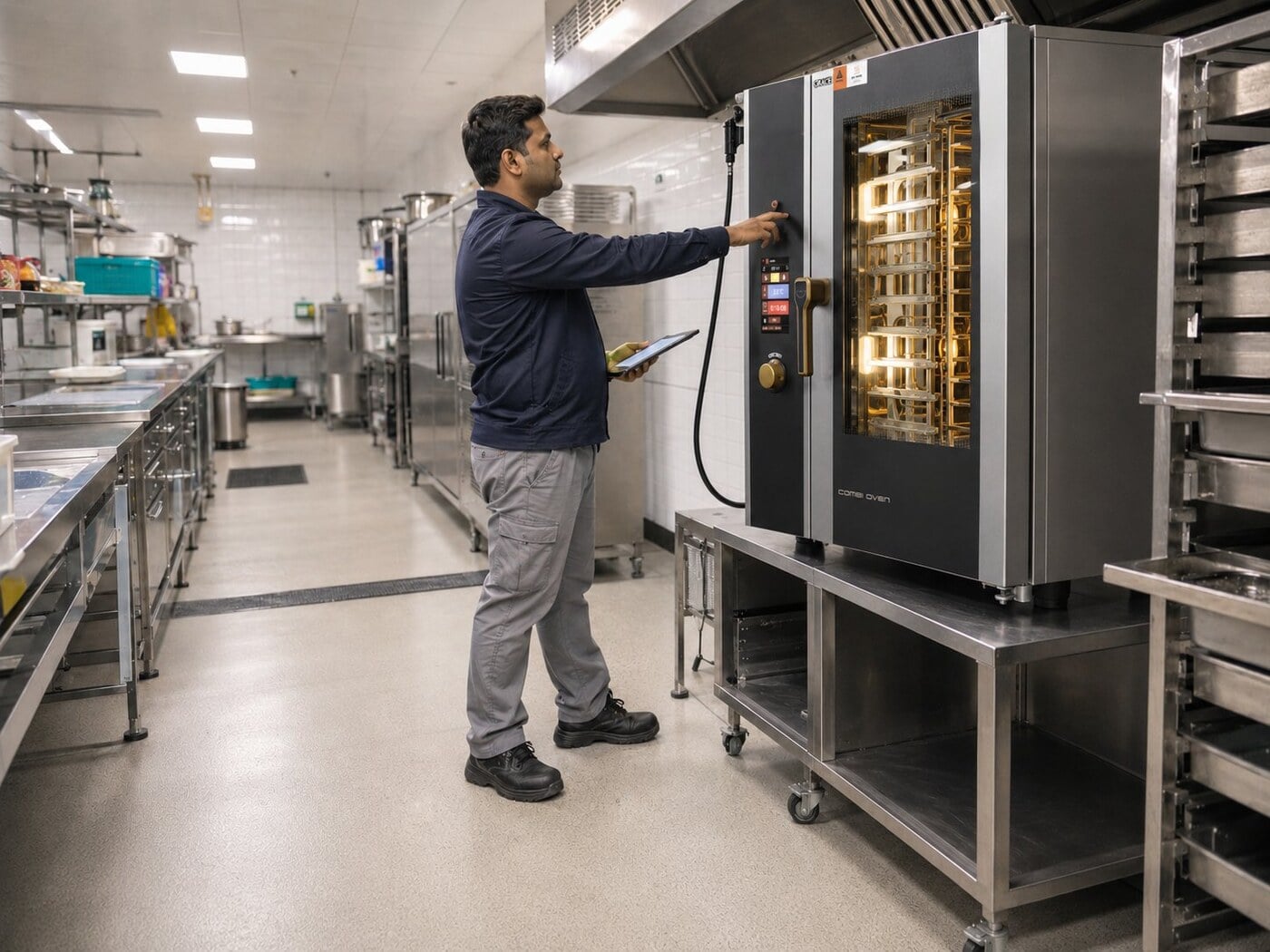
On-site commissioning — verifying a GRACE combi oven runs to specification before handover, with operating procedures captured for staff training.
On-site engineers for installation and cook-chill commissioning
System-level validation — production line tested at full throughput
Operator training on equipment use, HACCP procedures and cleaning
Warranty, spare-parts supply and remote technical support
On-site service available across our 130+ country project base
Real Central Kitchen Projects We Have Delivered
The most reliable signal of whether a contractor can run this process is the projects already on record. The following are representative completed central kitchen and food-production projects.
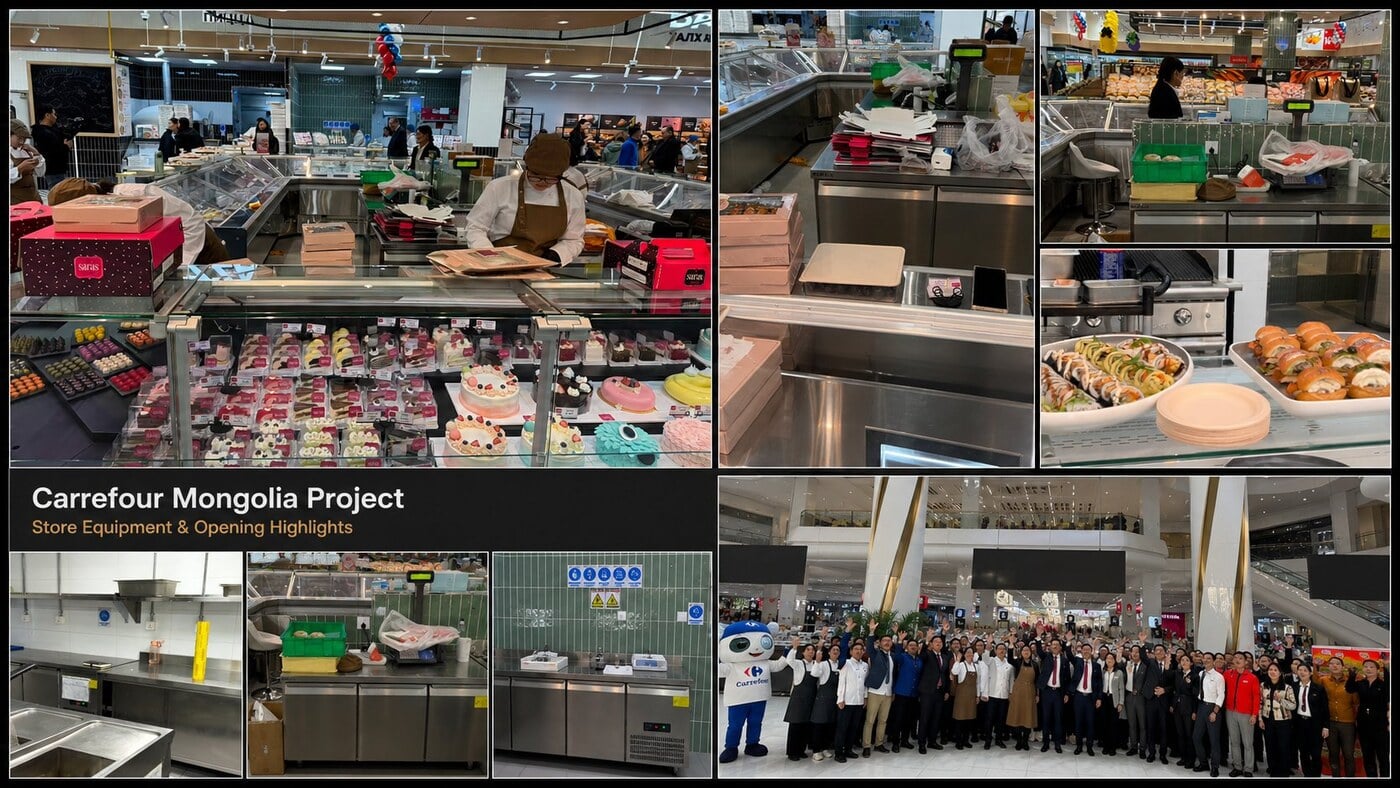
Carrefour Mongolia — store-equipment installation and opening day, with GRACE-supplied bakery counters, refrigerated display cases, sushi station and prepared-food production behind the scenes.
Carrefour — Mongolia
Supermarket chain · Prepared-food central kitchen & in-store production
A supermarket-chain central kitchen and in-store production project for Carrefour in Mongolia, supplying prepared-food production, bakery, refrigerated displays and the cold-chain that links them. Scope covered the production line, cook-chill backbone, cold storage, dispatch staging and the front-of-store display equipment — designed for the daily prepared-meals throughput Carrefour required and built to international supermarket-supplier compliance standards.
A commissary central kitchen for a regional restaurant chain in East Africa, supplying multiple outlets with prepared sauces, par-cooked proteins and cold-chain ready components. GRACE delivered the production line, blast chillers and cold storage with tropical-rated refrigeration for the local 35–43°C ambient — essential for cook-chill reliability in that climate.
Food Court Central Kitchen — Middle East
Multi-brand food court · Centralised production
A centralised production kitchen serving multiple branded outlets inside a Middle East shopping-mall food court, designed for shared raw storage, prep and cold-chain backbone with brand-separated cooking stations on the outlet side — a model that reduces total equipment cost across multiple operators sharing one back-of-house.
Institutional Catering — CIS Region
School / hospital catering · High-volume daily meals
An institutional central kitchen project in the CIS region serving school and hospital sites at scale, delivered with Russian-language documentation and CIS-market specifications. Design priorities included high-volume bulk cooking, cook-chill for safe transport to multiple sites, and HACCP compliance to local regulatory standards.
📄
Want the full central kitchen case studies?
Completed central kitchen projects each have a full project brochure with HACCP zoning drawings, capacity calculations, 3D renderings, on-site installation photos and the complete equipment list. We send these directly to qualified operators, consultants and developers on request.
Email [email protected] with your project location and target daily output, and we will share the relevant case studies.
Why GRACE — The Underlying Capability
The six-phase process is only reliable because of what sits behind it. Five things define our capability on central kitchen projects:
Capability
What it means for your project
22,000㎡ in-house facility
Production line, cook-chill, cold storage and stainless fabrication made under one roof — one quality standard across the whole central kitchen
13 product categories · 4,800+ SKUs
Every zone of a central kitchen covered without sub-contracting to second or third suppliers
Cook-chill expertise · IceStorm brand
Blast chillers and freezers built and matched to your production-capacity peak — the backbone that makes a central kitchen actually work at scale
20 years & 3,000+ projects
The 6-phase process is proven on real central kitchens at supermarket, restaurant-chain, food-court and institutional scale
CE · SGS #487222625_T · Intertek · ISO 9001
Documented certification for European, Middle Eastern and brand-supplier-standard projects, including supermarket chains
This is also why GRACE delivers projects beyond central kitchens — hotel kitchens, bakery production lines, banquet kitchens and cold-chain installations through our IceStorm brand. Each project type follows the same 6-phase discipline. Detailed process guides for those project types are published as part of this series.
Frequently Asked Questions
What is a turnkey central kitchen project?
One contractor delivers the complete production facility — capacity design, equipment manufacturing, cook-chill backbone, installation and commissioning. The operator signs one contract and receives a working facility, not a stack of separately-sourced equipment.
How long does a GRACE central kitchen project take?
Typically 12–16 weeks from design sign-off to on-site delivery: 60–90 days production, 14–28 days sea freight, then installation. Larger facilities with multiple production lines take longer.
What output capacity can GRACE design a central kitchen for?
From 500 meals per day to 50,000+ meals per day, including supermarket prepared-food central kitchens, restaurant-chain commissaries, food-court central kitchens, institutional catering kitchens and food-processing facilities.
Why is cook-chill the backbone of a central kitchen?
Cook-chill lets the kitchen cook in batches, rapidly chill through the food-safety danger zone within 90 minutes, store safely and regenerate at the outlet. Without cook-chill, output capacity is limited and food safety cannot be guaranteed at scale. The blast chiller must be sized to peak cooked output — undersizing it caps the whole facility.
Does GRACE handle HACCP-compliant zoning design?
Yes. HACCP-compliant zoning is built into the Phase 2 layout: raw, preparation, cooking, blast-chill, cold storage and dispatch zones with no crossing flow between raw and cooked. The layout is reviewed against the destination country's food-safety regulations.
Can GRACE design for hot-climate central kitchens?
Yes. For Africa, the Middle East and tropical Asia, refrigeration and cook-chill equipment is specified with tropical rating (43°C+ ambient) — essential for a central kitchen's cold-chain backbone to operate reliably in those climates.
Start a Central Kitchen Project with GRACE
Send us your target daily output, distribution model and site footprint. Phase 1 begins within 48 hours — and the capacity design that comes out of Phase 2 is free.