
How to Bake Cinnamon Rolls in a Commercial Convection Oven

Make 16 large cinnamon rolls with a soft crumb, a defined cinnamon swirl and a light vanilla glaze. Use two trays and establish a repeatable bake for your bakery or café.
Vanilla-glazed cinnamon rolls. AI-generated illustration.
Ingredients for 16 rolls
Use two lined 400 × 600 mm trays, eight rolls per tray. The dough weighs about 1,364 g before the milk paste loses moisture and before handling losses. Divide the actual dough weight in half. Each filled roll starts at about 103 g before baking and glazing.
| Stage | Ingredients by weight |
|---|---|
| Cooked milk paste (tangzhong) | 226 g whole milk, 48 g bread flour |
| Dough | All the cooked paste, 302 g cold whole milk, 600 g bread flour, 50 g granulated sugar, 12 g fine salt, 12 g instant yeast, 114 g softened unsalted butter |
| Filling | 28 g melted unsalted butter, 214 g light brown sugar, 28 g bread flour, 16 g ground cinnamon, 1 g fine salt |
| Finishing and glaze | 84 g melted unsalted butter, divided equally, 340 g confectioners’ sugar, 28–56 g whole milk, 4 g vanilla extract, 1 g fine salt |
This two-tray batch adapts the King Arthur Baking cinnamon roll formula for a café bake. The rolls contain wheat and milk.
Mix, shape and proof the rolls
- Cook the milk paste. Whisk the 226 g milk and 48 g flour until smooth. Stir over medium heat until the mixture thickens and a spatula leaves a line across the bottom of the saucepan. Scrape into the mixing bowl and stir in the cold milk.
- Mix the dough. Add the flour, sugar, salt, yeast and softened butter. Mix on low with a dough hook until combined, then knead within your mixer’s speed and batch limits until the dough is smooth, elastic and slightly tacky. Keep it covered until puffy. Allow roughly 60–90 minutes for this first rise, depending on your kitchen.
- Make and divide the filling. Mix the melted butter, brown sugar, flour, cinnamon and salt to a crumbly paste. Weigh the dough and filling separately, then split each into two equal portions.
- Shape 16 rolls. Roll each half of dough into a rectangle about 25 × 30 cm. Spread half the filling over each rectangle and leave a narrow strip bare along one long side. Roll toward that bare edge, pinch the seam and cut each log into eight even pieces.
- Proof on trays. Space eight rolls on each lined tray, leaving room for the rolls to expand without touching. Cover and proof until the rolls look full and a light fingertip dent springs back slowly. Check by touch and appearance since room temperature changes the timing.
Bake on the GRACE GR-5DH
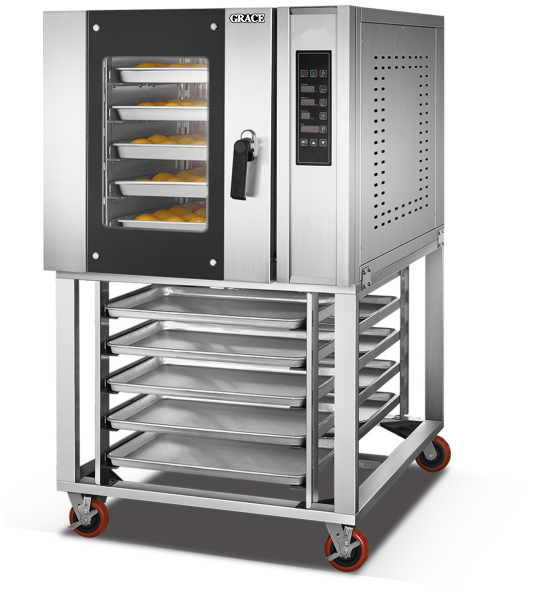
| Specification | GR-5DH |
|---|---|
| Heating | Electric convection |
| Tray capacity | Five 400 × 600 mm trays |
| Supply and rated power | 380 V, 50 Hz · 7.5 kW |
| Listed temperature range | 30–400 °C |
- Preheat for a one-tray test. Select the convection bake mode according to the oven manual. Ask the equipment team for an initial setting for eight individual rolls on a full-size tray and wait for the oven to stabilize. King Arthur’s conventional-oven benchmark is 190 °C (375 °F) for 14–18 minutes. Use it as a recipe reference when setting up the first convection trial.
- Check the centre and the colour. Load one tray in an approved rack position and record the setpoint, position and bake time. Check a roll near the middle of the tray. It should be light golden and set in the centre, with the bread around the swirl soft and free of raw dough. The source recipe uses about 88 °C (190 °F) at the centre as a bake-quality reference. Probe the dough rather than the cinnamon filling.
- Confirm the two-tray bake. Repeat with two trays in separate approved positions. Check the colour and centre of rolls from both trays. If the bake varies by position, adjust one factor at a time and record the combination that works. Add those settings and the expected batch weight to the station card.
- Glaze warm rolls. Brush the baked rolls with half the melted butter and transfer to a cooling rack. Whisk the other half with the sugar, vanilla and salt. Add the milk gradually until the glaze drizzles. Apply it while the rolls are warm and let it set before packing.
- Clean the oven. Follow the manual’s shutdown and cool-down steps. When it is safe to handle the trays, remove the liners and clear loose crumbs. Clean trays, racks and the oven cavity as directed by the manufacturer. Keep liquid away from the controls.
Troubleshoot the first batch
| Result | What to change |
|---|---|
| Dense, tight rolls | Check yeast freshness and allow the shaped dough to become visibly puffy before loading. |
| Dark tops and doughy centres | Check portion weights, then test a lower approved setpoint with a longer bake. Compare the centre and top before adding a second tray. |
| Filling leaks or the swirl opens | Keep a clean sealing strip, pinch the seam and place the seam end against the tray. Use the same filling weight on both dough sheets. |
| Glaze runs off | Let the rolls cool a little longer and add the final milk to the glaze in small increments. |
For equipment selection, share your tray size and peak batch requirement with GRACE. Browse GRACE bakery equipment.