
How to Bake Pumpkin Pie in a Commercial Convection Oven
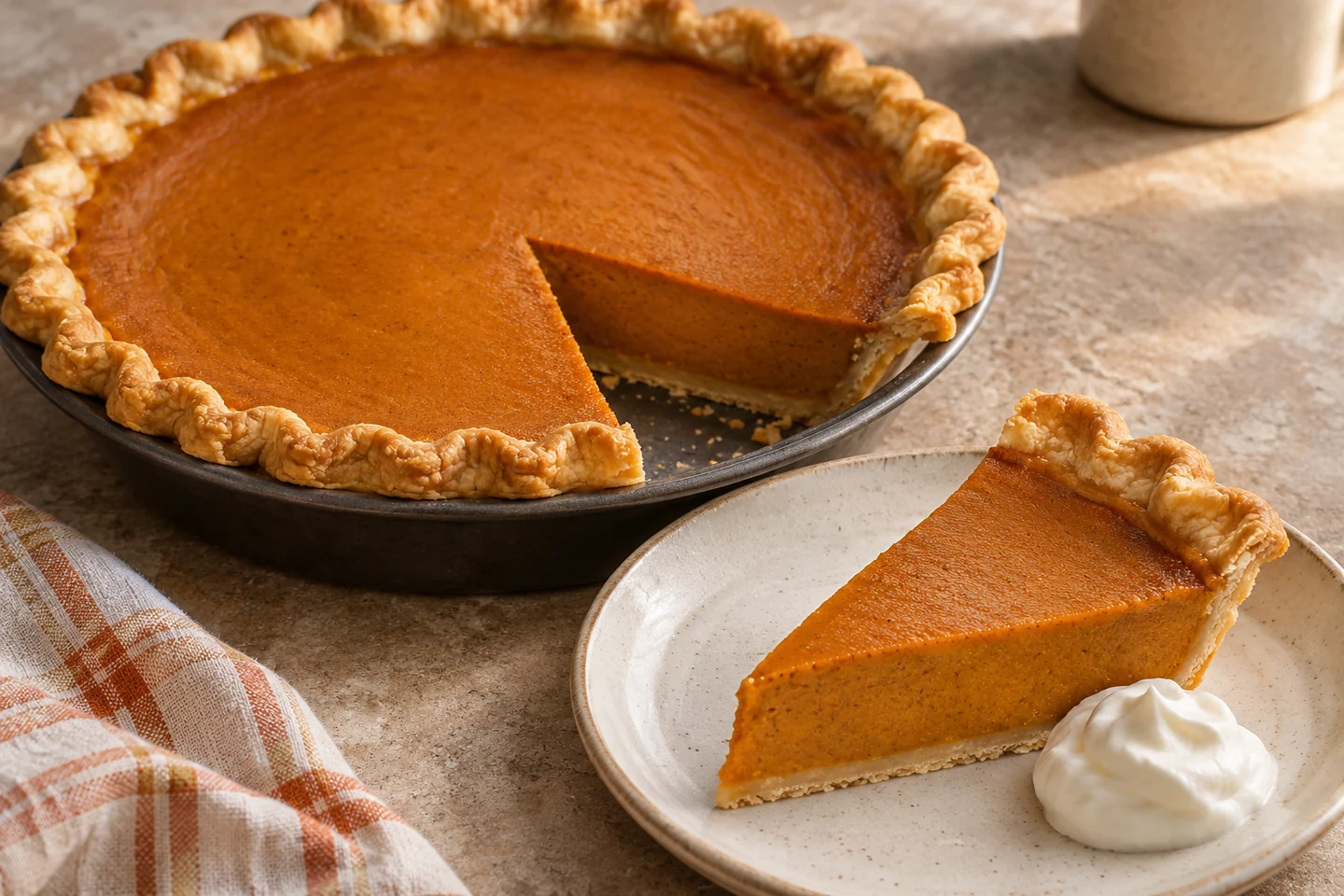
Make six deep 9-inch American pumpkin pies for a café display or holiday preorders. The goal is a flaky golden base with a smooth spiced custard that slices cleanly once chilled.
Classic American pumpkin pie with a crisp butter crust. AI illustration.
Batch formula: Six 9-inch pies
Target yield: Six pies, or 48 slices if you cut each pie into eight. Use six matching 23 cm (9 in) metal pie pans, about 4 cm (1½ in) deep, with rims no wider than 26 cm for the two-per-tray layout. Have three 400 × 600 mm baking trays, pie weights, a scale, a wire rack and a calibrated food probe ready. For a two-pie pilot, make one-third of the formula below.
| Component | Ingredient | Batch weight |
|---|---|---|
| Butter crust | All-purpose flour | 930 g |
| Cold unsalted butter, cubed | 630 g | |
| Ice-cold water, weighed without ice | 300 g | |
| Fine salt | 18 g | |
| Total dough | 1,878 g | |
| Pumpkin filling | Plain unsweetened pumpkin purée | 2,520 g |
| Unsweetened evaporated whole milk | 1,980 g | |
| Whole egg, weighed without shells | 600 g | |
| Light brown sugar | 840 g | |
| Ground cinnamon | 24 g | |
| Ground ginger | 12 g | |
| Ground nutmeg | 6 g | |
| Ground cloves | 3 g | |
| Fine salt | 15 g | |
| Total filling before transfer | 6,000 g |
Allow about 313 g dough per pan before trimming and aim for 980 g filling per shell. The extra 120 g of filling allows for bowl and jug losses. On the first trial, verify that the portion leaves at least 5 mm below the pastry rim. If your pans are shallower, weigh and record the reduced fill for all six so the pies bake evenly. Contains wheat, milk and egg.
Which GRACE oven fits the batch?
The GRACE GR-5D electric convection oven fits this café batch: three of its five tray positions can carry two pies each, with room to leave positions open during your test. A bakery that needs to bake more trays in one cycle can consider the eight-tray GR-8D or the ten-tray GR-10D. Both use the same tray format, but each has a listed 15 kW load. Validate your bake and cooling capacity before increasing batch size.
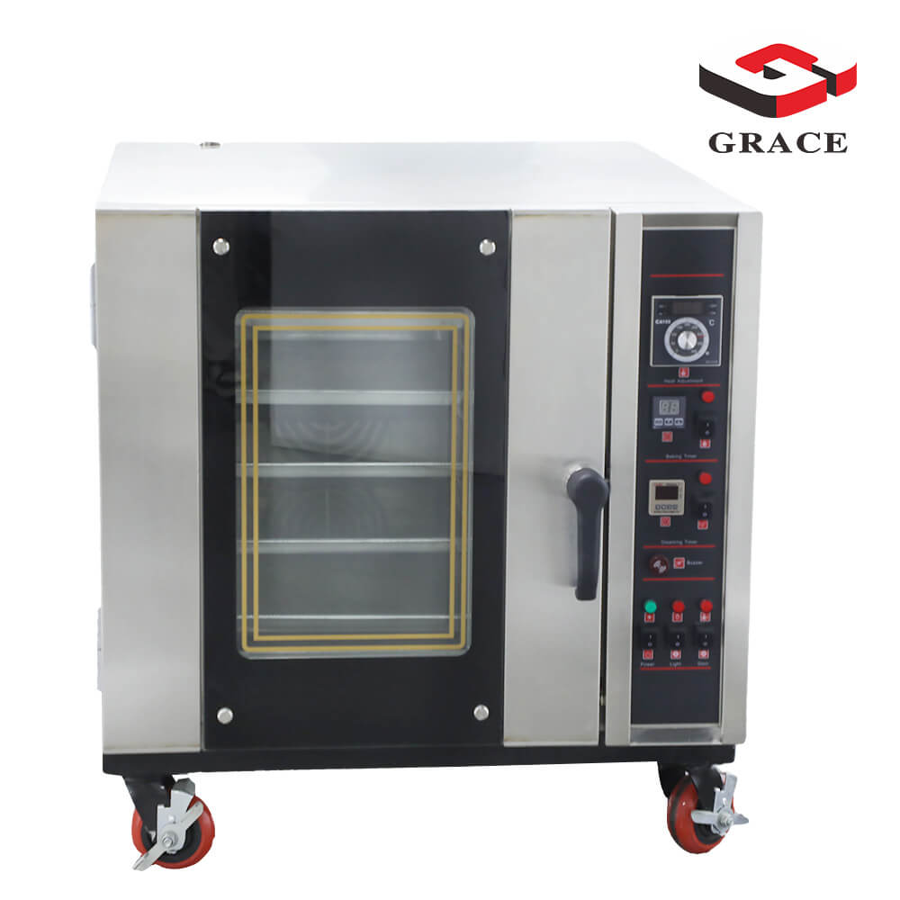
| Specification | GR-5D |
|---|---|
| Heating | Electric hot-air convection |
| Rated capacity | 5 trays, 400 × 600 mm |
| Listed supply and power | 380 V / 50 Hz, 7.5 kW |
| Listed temperature range | 30–400°C |
Before installation, have your installer check the exact unit nameplate against the site’s voltage, phase, frequency and circuit. Check the supplied trays and pan fit as well; two pans should sit flat along the long side of the tray without touching each other or the tray rim.
How to make and bake the pies
- Mix and rest the pastry. Stir the flour and salt together, then cut in the cold butter until most pieces are pea-sized. Add the cold water gradually and fold just until the dough comes together when pressed. Divide it into six equal discs, wrap, and refrigerate for at least 30 minutes so it can roll without springing back.
- Line the pans and mix the custard. Roll each disc about 3 mm thick, ease it into the pan without stretching it, and fold and crimp the edge. Chill the lined pans for about 30 minutes. Separately, stir the sugar, spices and salt, then whisk them into the pumpkin and eggs. Stir in the evaporated milk until smooth. Keep the filling covered and refrigerated until you are ready to weigh it into the shells.
- Start the GR-5D and preheat for the shells. Check that the oven is clean and clear of obstructions, then power it on. Set dry convection to 175°C (347°F) for the first trial. An independent oven thermometer at tray height can confirm that the empty chamber has stabilized. Line the shells with oven-safe parchment held down by pie weights and place two pans on the middle tray for the pilot. Check from 18 minutes. Lift out the liner and weights once the sidewall holds its shape. Return the shells for a few more minutes if the base still looks wet. The base should look dry and lightly colored; the rim will brown further with the filling. See King Arthur Baking’s guide to prebaking pie crust.
- Load and bake the custard. Set the oven to 160°C (320°F) and allow it to settle at the new setting. Weigh the custard into the shells on a level worktop just before loading. Slide the tray in level, leaving clearance around each pan, and close the door gently. For the two-pie pilot, make the first check at about 32 minutes. Use short additional intervals and record the actual finish time. Repeat with three spaced tray positions when you scale to six pies; check again from the pilot’s first-check time and compare the pies on each position.
- Check the center, then cool promptly. The crust should be golden and the outer custard set; a small area in the center can still wobble together without rippling like liquid. During the trial, probe the center of each pie you test without touching the metal base. Use at least 71.1°C (160°F) in the center as the USDA minimum benchmark for egg dishes; do not rely solely on appearance. Take out the finished pies and cool in a single layer with airflow between pans in a protected area. Move promptly to approved rapid cooling equipment and log the center temperatures. Where the FDA Food Code time-and-temperature controls apply, cool from 135°F to 70°F within two hours and to 41°F or below within six hours total. Once fully chilled, cover, label and refrigerate under your local food safety plan. Slice cold with a clean knife.
- Shut down and clean. Switch the oven off and let it cool. Follow site procedures and the supplied instructions for isolating power and cleaning. Remove the trays and wash them separately. Wipe cooled spills and the door seal with approved products and a soft cloth. Keep water away from the controls and fan openings. Remove cleaner residue as directed and dry the chamber before the next shift.
Record before staff training: pan size, fill weight, tray positions, verified chamber temperature, each position’s bake time and center temperature, and the cooling log. Repeat at the intended batch size before setting the shop’s standard. The temperatures and check times above are recipe trials; the oven’s five-tray rating is its rack capacity.
What to change if a batch misses the mark
| Problem | Adjustment for the next trial |
|---|---|
| Pale or damp base | Use matching metal pie pans and let the base dry during the unweighted part of the prebake. Check the tray position before increasing bake time for the custard. |
| Cracks or grainy filling | Check the temperature sooner and pull each pie once it meets the center-temperature benchmark and the edges have set. If the edges still overcook before the center is ready, test a slightly lower oven setting. See King Arthur Baking’s notes on why custard cracks. |
| One tray finishes ahead of another | Confirm the same pan type and fill weight across positions. Pull each tray when ready, record the pattern and reduce the load or change rack spacing on the next trial if needed. |
| Slices slump after chilling | Check the recorded center temperature and cooling history. If those met your plan, verify the filling was made with plain pumpkin purée, recheck the fill weight and wait until the pies are fully chilled before cutting. |