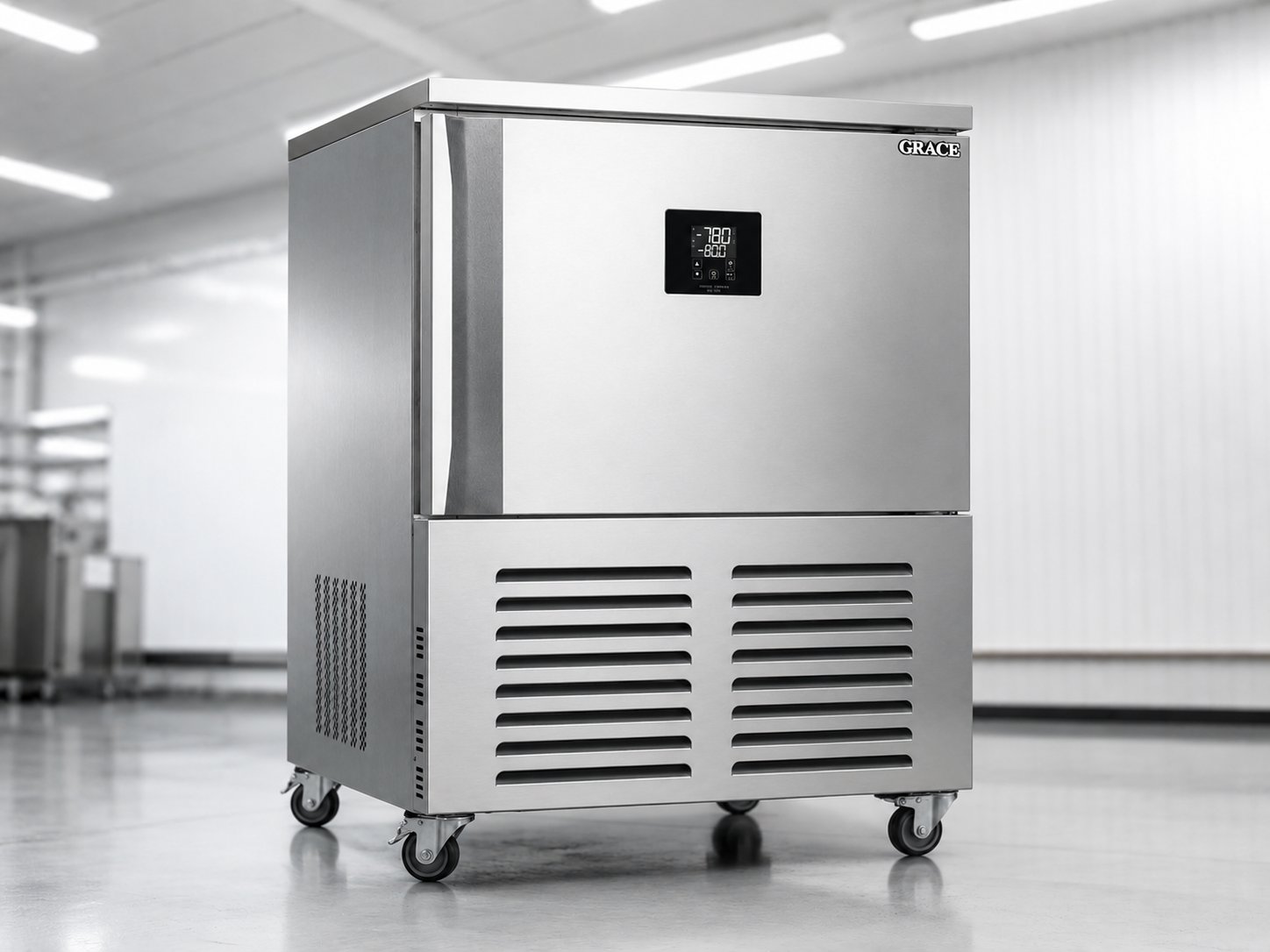
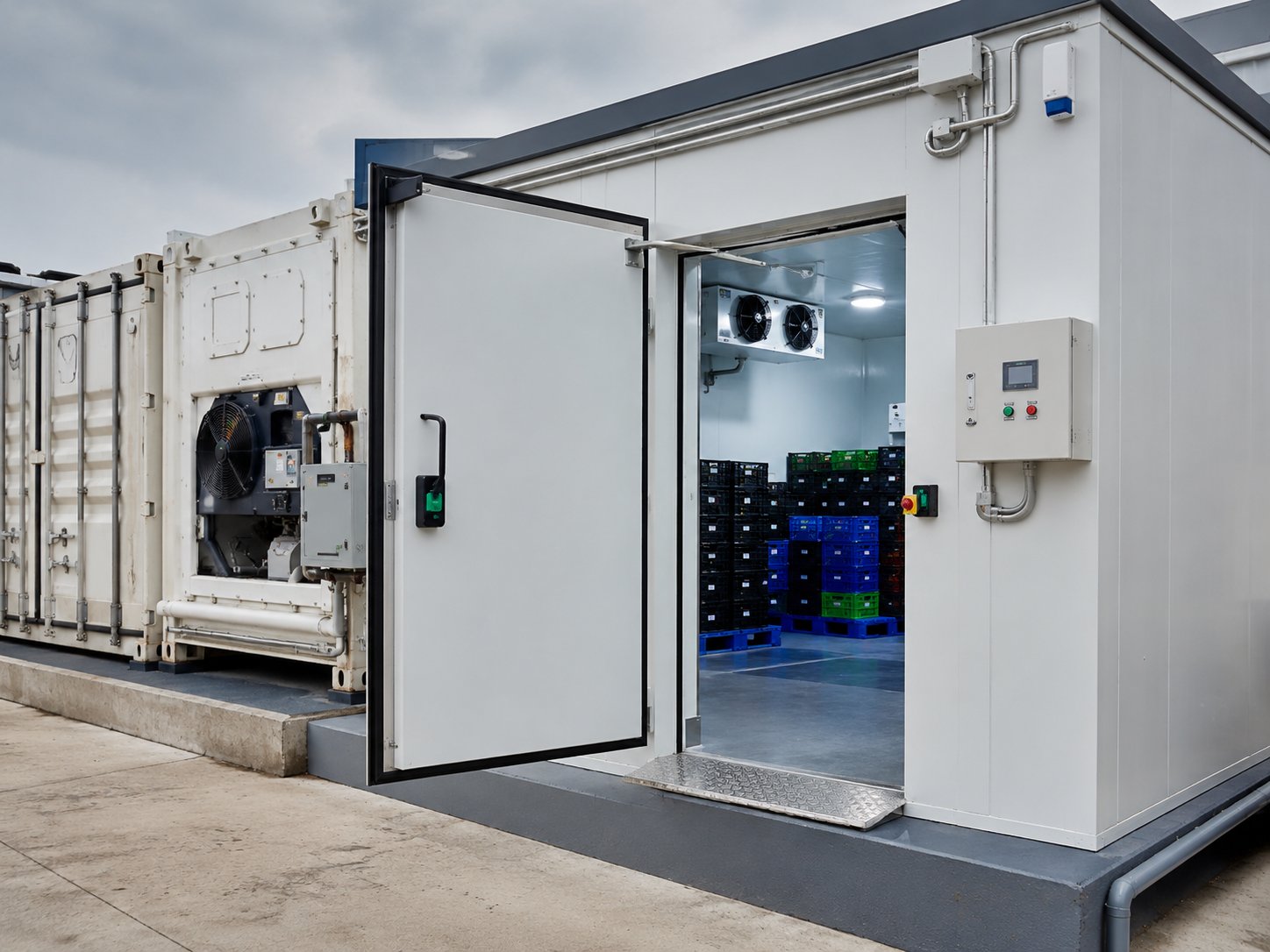
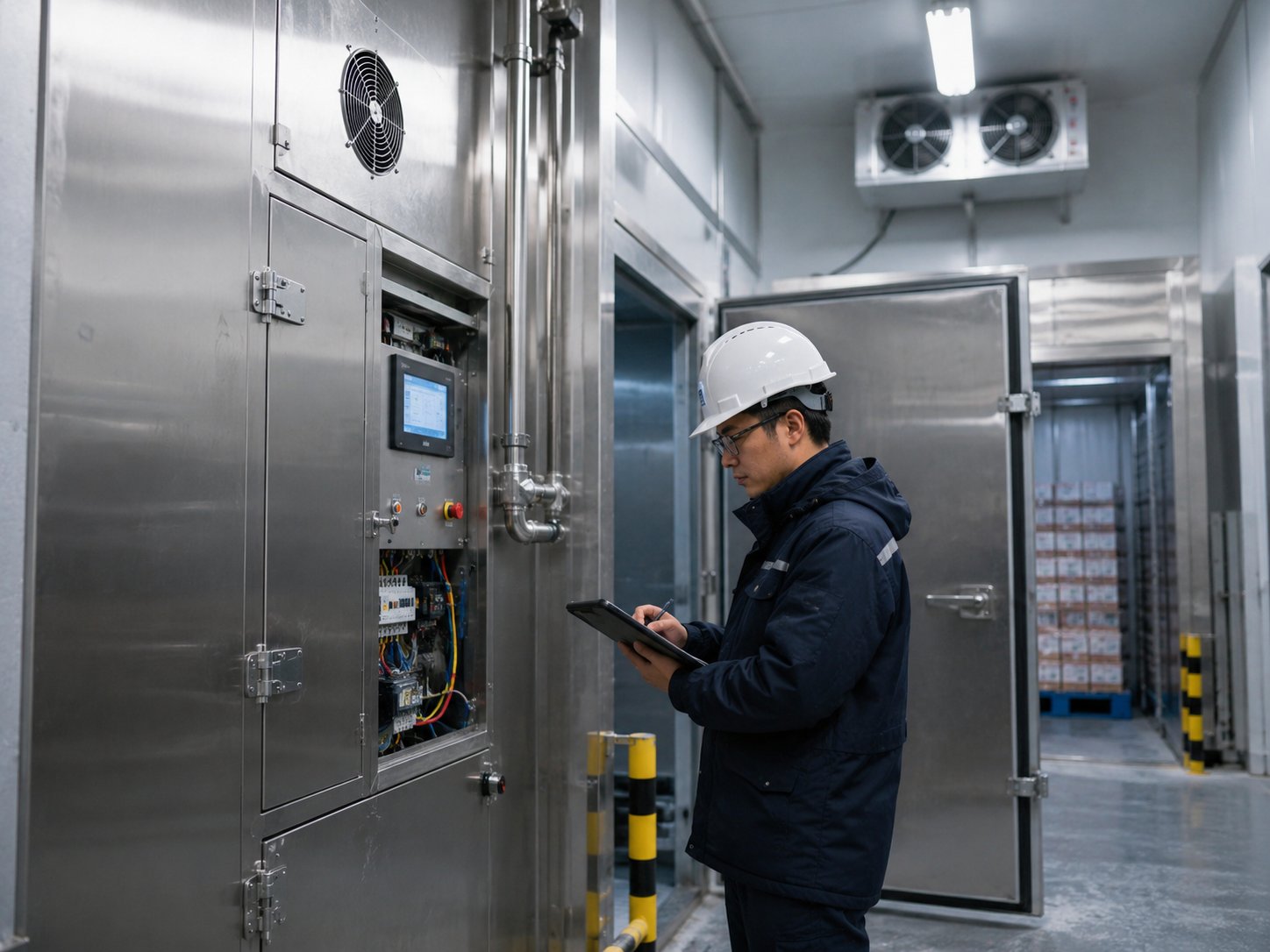
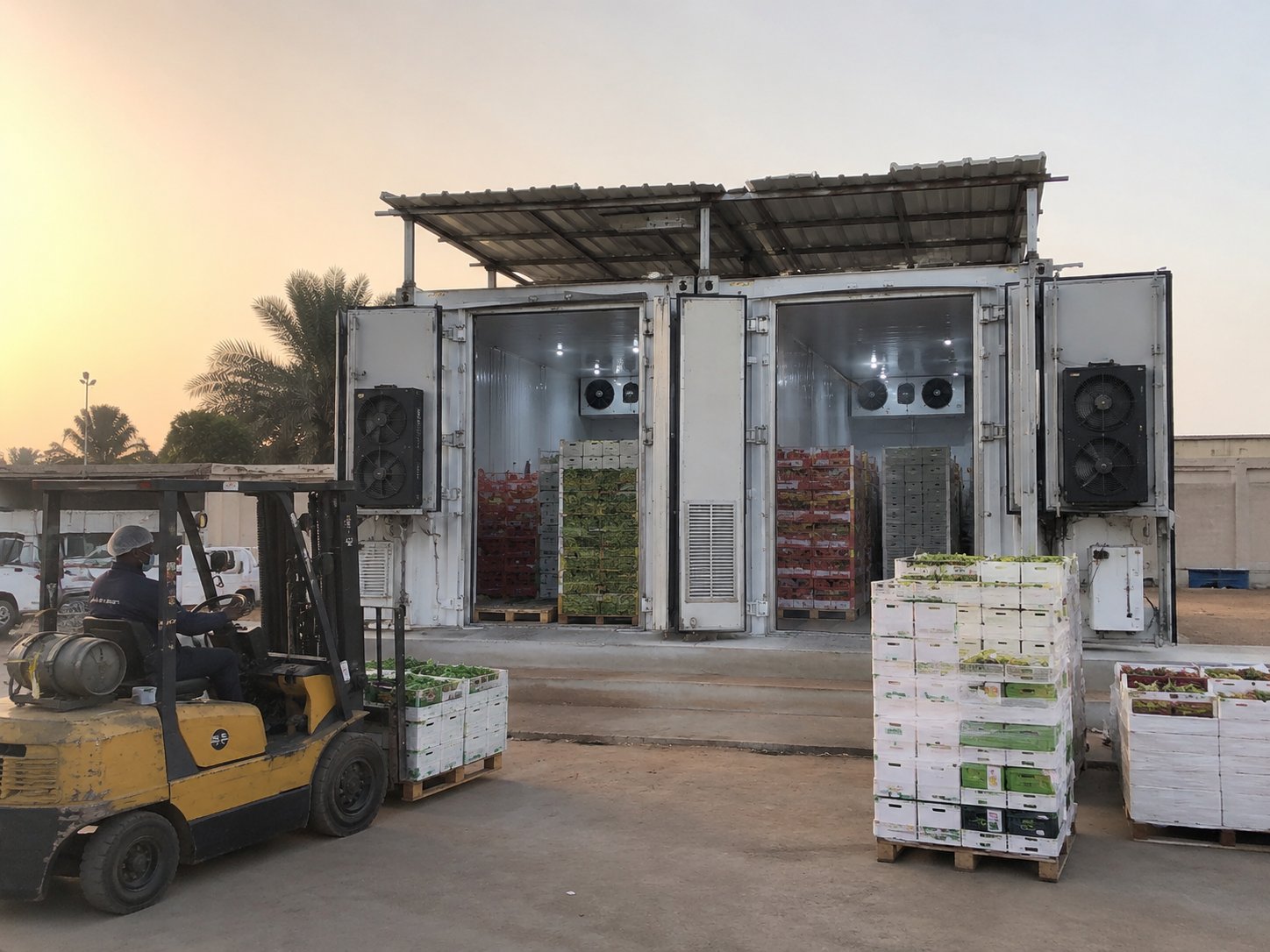
IceStorm Blast Freezer CabinetTropical-rated blast freezer for 43°C+ ambient — engineered for East Africa and Middle East cold-chain operationsWalk-In Cold Storage ContainerModular container cold-chain installation for remote and tropical-climate sites
Cold chain is unforgiving. A blast freezer that runs hot for two hours loses an entire production batch. A cold room that warms by 3°C during a daytime power-cycle pushes food into the danger zone. A condenser sized for temperate climate fails when ambient hits 43°C in July — and food spoils before anyone notices the warning. Cold chain failures don't show up as warnings; they show up as wasted product, rejected shipments, and lost customers. This is why the cold chain has to be engineered as one system from the start — load calculation, equipment sizing, panel construction, refrigeration, electrical, controls and commissioning, all bound together — not assembled from separately-sourced parts that nobody owns end-to-end.
This article walks through how GRACE, through our dedicated cold-chain brand IceStorm, delivers complete cold storage and blast freezer installations as turnkey projects — engineered specifically for the tropical climates where standard temperate-rated refrigeration fails. We cover our 6-phase process from load briefing through commissioning, the real cold-chain projects we have built across East Africa, the Middle East and 130+ countries, and what an operator can expect at each stage.
🧊
IceStorm — GRACE's Cold-Chain Brand
"Freeze Fast. Waste Nothing."
IceStorm is GRACE's dedicated brand for blast freezers and cold storage installations in tropical and hot-climate markets — East Africa, the Middle East, and tropical Asia. Engineered for 43°C+ ambient operation, where temperate-rated refrigeration loses capacity, draws more power and fails earlier.
2006Founded
22,000㎡Manufacturing facility
3,000+Projects completed
130+Countries served
Key Takeaways
GRACE delivers cold-chain installations as turnkey projects through our IceStorm brand — one contract covering load calculation, blast freezing, cold storage, refrigeration, electrical and commissioning.
Every project is sized to a documented heat-load calculation — not estimated by floor area or guess.
Tropical-rated 43°C+ ambient specification is the default, not an upgrade — engineered into the condenser, compressor and controls from the start.
Capacity scales from 1-ton single blast freezer to 3-ton walk-in and multi-container cold-chain installations, with modular expansion paths.
Project record concentrated in East Africa, the Middle East, the CIS region and tropical Asia — markets where standard refrigeration fails.
Cold storage and blast freezing are not equipment categories — they are engineered systems. A blast freezer is not a freezer that runs colder; it is a thermally-modelled environment with airflow, evaporator surface area, compressor capacity and panel insulation all calculated to drop a known mass of product through the food-safety danger zone within 90 minutes. A cold room is not a refrigerated container; it is a heat-load problem with door-opening cycles, infiltration, lighting, fans, motors and product respiration all summed and sized for the worst day of the year. Get the calculation wrong and the equipment never reaches its setpoint — or runs constantly trying to. This is why cold-chain projects fail more often than any other category in food infrastructure: not because the equipment is bad, but because nobody owned the load calculation that should have determined what equipment to install.
What an operator actually needs is a contractor who owns the calculation, the design, the manufacturing, the panels, the refrigeration, the electrical, the commissioning and the after-sales — for the climate where the project actually operates. In East Africa, the Middle East and tropical Asia, that climate is 43°C+ ambient in summer with high humidity and unstable power supply. This is what an IceStorm turnkey cold-chain project delivers — and what GRACE has been doing across these markets for over twenty years.
The IceStorm 6-Phase Cold-Chain Project Process
Every cold-chain installation we deliver follows the same six phases. Sequence and discipline are how heat-load targets are actually hit — and how an operator knows, at every stage, exactly where the project stands.
PHASE 1
Consultation & Load Briefing
Typical duration: 5–10 days
The project starts with the product and the climate, not the equipment. We need to understand: what's being stored or frozen (meat, seafood, dairy, vegetables, par-baked, ready meals), incoming product temperature and target temperature, peak daily throughput (tons in / tons out per day), required hold time, ambient peak temperature for the worst month of the year, door-opening frequency, and the destination country's electrical supply and stability.
Product profile and target temperature ranges (chill +2~+4°C / freeze -18°C / blast -35°C)
Peak daily throughput and required hold capacity
Ambient design temperature for the worst month — typically 38–45°C in target markets
Electrical supply, voltage, frequency and stability (generator backup if relevant)
Output: a written load brief signed off before design starts
PHASE 2
Heat-Load Design & Sizing
Typical duration: 7–14 days
From the load brief, our refrigeration engineers calculate the total heat load — product load (sensible + latent + respiration), transmission load through panels, infiltration load through door openings, internal load from lights, fans and motors, and a safety margin for the worst-day scenario. From that total comes the refrigeration capacity, evaporator surface area, condenser sizing for tropical ambient, compressor selection and panel thickness. Every number is documented; nothing is guessed.
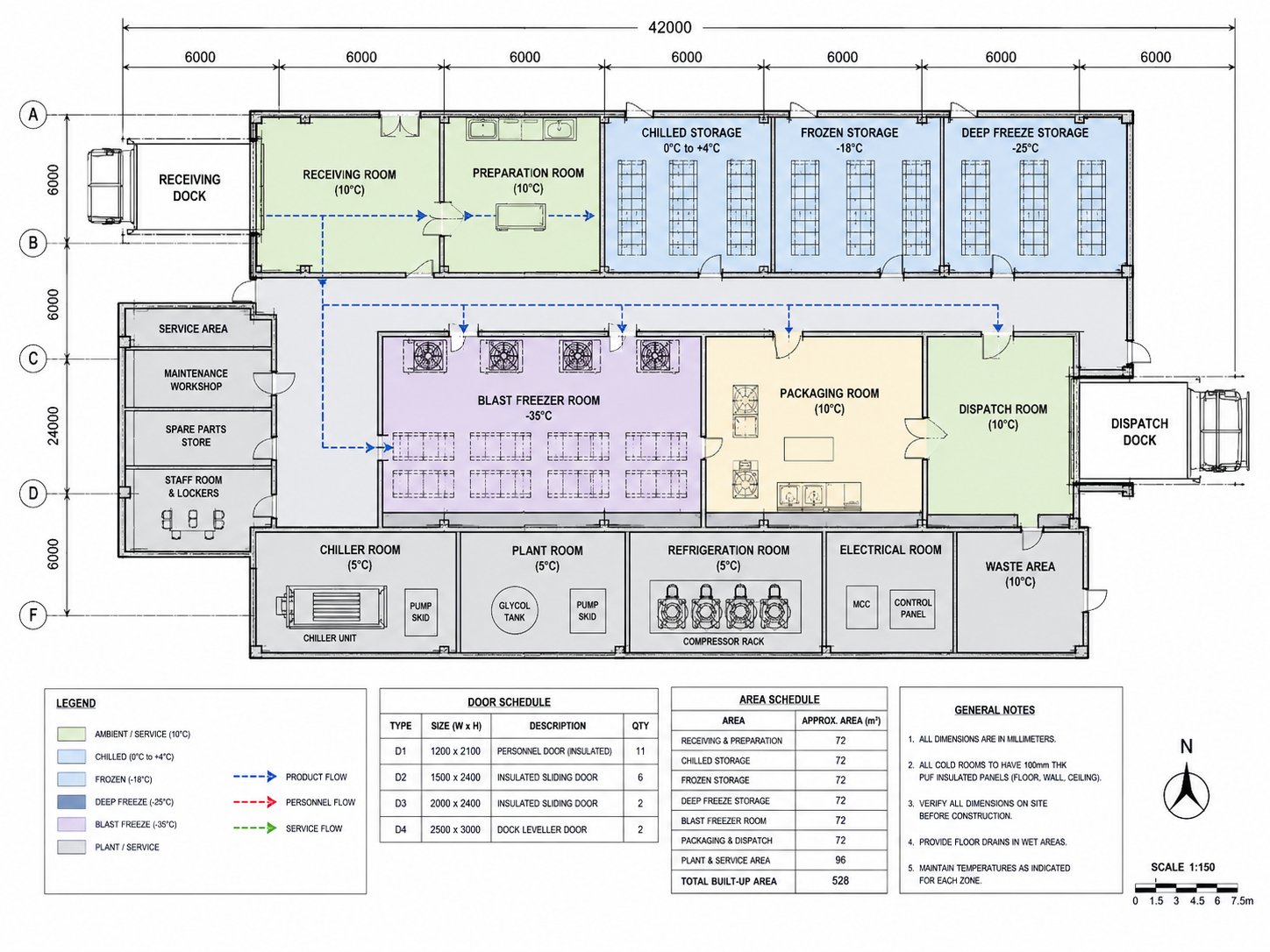
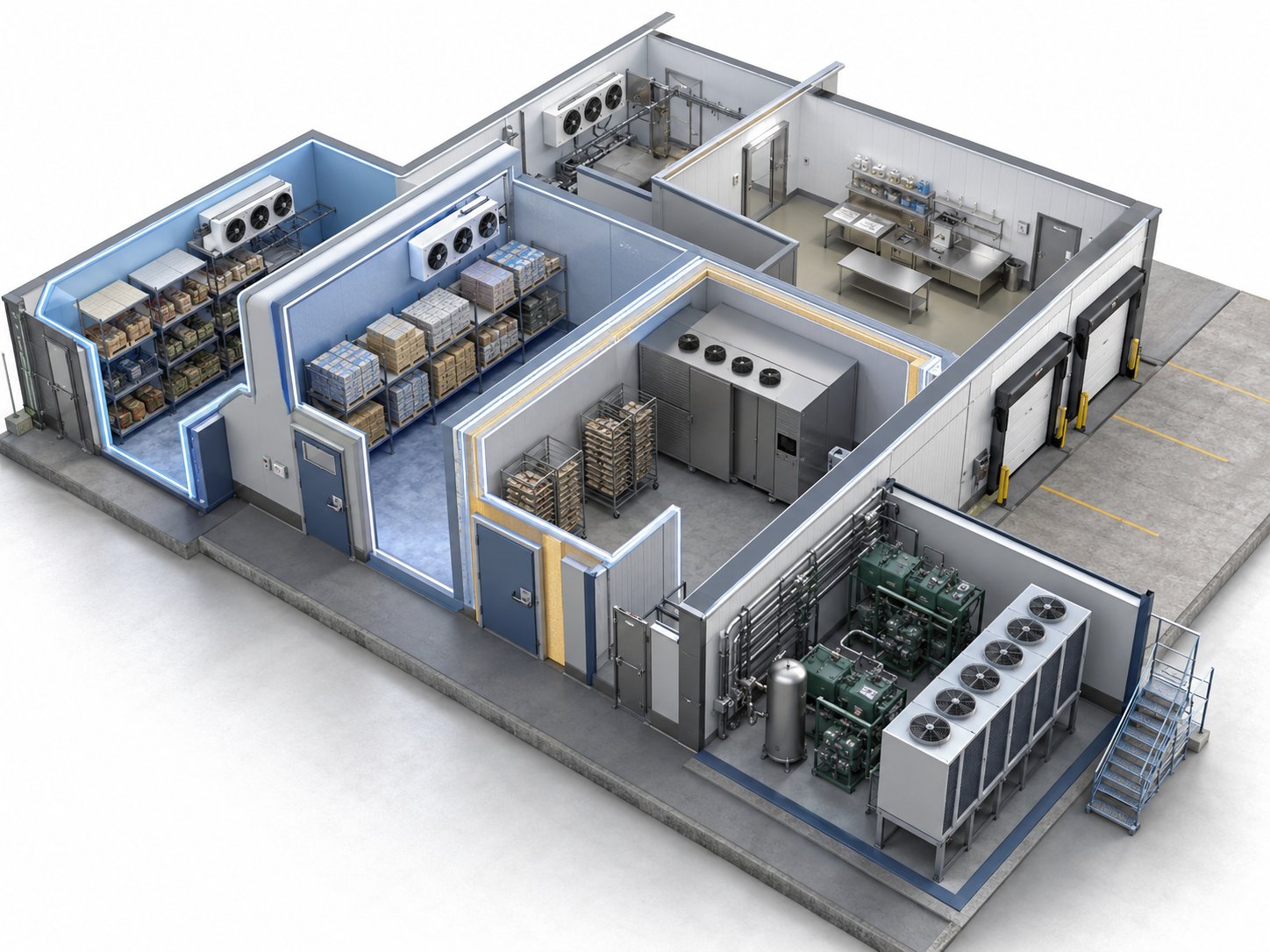
Cold storage facility layout — multi-temperature zoning with blast freeze (−35°C), frozen storage (−18°C), chilled storage (0–4°C) and dispatch, designed for a 528㎡ installation. Tropical-rated condenser and refrigeration system sized per documented heat-load calculation.IceStorm 3D cold storage facility rendering — cutaway view showing blast freezer zone, multi-zone cold storage, refrigeration plant and dispatch staging. Delivered as part of the Phase 2 design package before quotation.
Refrigeration system designed for stable operation on unstable grid power
Design delivered at no charge as part of the proposal
PHASE 3
Specification & Quotation
Typical duration: 5–10 days
With the load design signed off, every item is specified against its role in the system — blast freezer cabinet or walk-in unit, panel system, compressor and condenser, evaporator coils, refrigerant type, controls, doors and door curtains, vapour barriers, floor system — and a complete itemised quotation is issued. Refrigerant choice and compressor selection are matched to the destination country's regulatory environment and service-parts availability.
Itemised quotation cross-referenced to the heat-load calculation
Tropical-rated condenser and high-temperature compressor as default
Service-parts availability confirmed for the destination market
Output: a signed contract and design freeze before manufacturing
PHASE 4
Manufacturing & Quality Control
Typical duration: 45–90 days
Manufacturing happens in our own 22,000㎡ Foshan facility. Cold chain demands consistency from the panel through the compressor — and because GRACE manufactures the panel system, refrigeration equipment and stainless components in-house under the IceStorm brand for cold-chain projects, one quality standard runs across the whole installation. Every system passes leak-test, pressure-test and run-test cycles before packing; clients are welcome to factory-visit or third-party inspect.
PU panel system manufactured in-house — vapour-tight construction
Refrigeration system pre-tested at the factory before shipping
Tropical-rated compressors and condensers specified and tested
QC inspection includes leak-test, pressure-test, run-test cycle
Client factory visit or SGS/Intertek third-party inspection welcome
PHASE 5
Export Logistics
Typical duration: 14–35 days sea freight
A cold-chain installation ships as a coordinated consignment — panels, refrigeration equipment, doors, floor system and electrical packaged for installation sequence. Larger projects may ship as containerised modular units pre-built at the factory, reducing on-site assembly time to days rather than weeks. We handle container loading, export documentation, customs clearance and shipping on the agreed terms.
Containerised modular cold rooms available — installed in days, not weeks
Full export documentation including CO, packing list, B/L
FOB, CFR or CIF terms as preferred
Insurance and damage-compensation mechanism included on CIF orders
PHASE 6
Installation, Commissioning, Training & After-Sales
Typical duration: 10–20 days on site + ongoing
On cold-chain projects we dispatch refrigeration engineers to site for panel assembly, refrigeration installation, evacuation and charging, controls programming and commissioning. The system is verified to hit its design temperature with full product load — not run empty for show. Pull-down curves are documented, hold tests run at ambient peak, and operators are trained on monitoring, defrost cycles and routine maintenance. Warranty, spare-parts supply and remote technical support continue across our 130+ country project base.
IceStorm refrigeration engineer commissioning a cold-chain installation on site — verifying pull-down curves at full product load and ambient peak temperature before handover.
On-site refrigeration engineers for panel and refrigeration system installation
System tested at full product load — pull-down curve documented
Hold tests run at ambient peak temperature
Operator training on monitoring, defrost cycles and routine maintenance
Warranty, spare-parts supply and remote technical support across 130+ countries
Real Cold-Chain Projects We Have Delivered
The most reliable signal of whether a contractor can run this process is the projects already on record. The following are representative completed IceStorm cold-chain installations in tropical and hot-climate markets.
IceStorm modular cold-chain installation — container cold storage units in service in East Africa and the Middle East, storing fresh produce and supporting regional food supply chains in 43°C+ ambient conditions.
A meat processing and cold storage installation for a regional food processor in East Africa — combining a 3-ton blast freezer for daily throughput with a walk-in freezer for hold capacity. Designed for 43°C+ ambient and built to IceStorm tropical-rated specification, with oversized condensers and high-temperature compressors as standard. The system pulls fresh product through the food-safety danger zone within 90 minutes — the basis of the operator's HACCP certification with regional regulators.
A seafood export facility in the Middle East with blast freezing for incoming catch, multi-zone cold storage for sorted product, and a dispatch zone for export containers. IceStorm delivered the panel system, refrigeration and controls — built to the seafood-export hygiene standards required for international shipment.
The back-of-store cold chain serving Carrefour Mongolia, supporting in-store prepared-food, dairy, meat and frozen-goods inventory. Scope covered walk-in cooler and freezer rooms, blast chillers for prepared-food cook-chill, and refrigerated dispatch staging — all built to international supermarket-supplier compliance standards.
Container Cold Chain — Mining & Remote Sites
Modular containerised installation · Remote site supply
Containerised cold-chain installations for mining camps and remote-site catering across Papua New Guinea, Central Asia and Africa — including the OK Tedi mining project. Pre-fabricated modular cold rooms ship in 20ft/40ft containers, installed on-site within days, and run reliably in remote conditions with limited refrigeration service infrastructure.
📄
Want the full cold-chain project case studies?
Completed cold-chain projects each have a full project brochure with heat-load calculations, pull-down curves, panel and refrigeration specifications, on-site installation photos and the complete equipment list. We send these directly to qualified food processors, exporters, supermarket operators and cold-chain logistics companies on request.
Email [email protected] with your product type, target capacity and destination country, and we will share the relevant case studies.
Why IceStorm — The Underlying Capability
The six-phase process is only reliable because of what sits behind it. Five things define IceStorm's capability on cold-chain projects:
Capability
What it means for your project
Tropical-rated as default
43°C+ ambient specification is standard, not an upgrade — condenser sizing, compressor selection and controls all engineered for hot-climate operation from the start
22,000㎡ in-house facility
Panel system, refrigeration equipment and stainless components made under one roof — one quality standard across the whole cold-chain installation
Modular capacity scaling
From 1-ton blast freezer cabinets through 3-ton walk-in units to multi-container installations, with modular expansion paths that don't require replacing the original system
Hot-climate market focus
Project record concentrated in East Africa, Middle East, CIS region and tropical Asia — markets where standard temperate-rated refrigeration fails routinely
CE · SGS #487222625_T · Intertek · ISO 9001
Documented certification for European, Middle Eastern, African and CIS-market projects, including food-export hygiene and supermarket-supplier standards
This is also why GRACE delivers projects beyond cold chain — hotel kitchens, central kitchens, bakery production lines and banquet operations. Each project type follows the same 6-phase discipline. Detailed process guides for those project types are published as part of this series.
Frequently Asked Questions
What is a turnkey cold storage & blast freezer project?
One contractor delivers the complete cold chain — load calculation, blast freezer sizing, panel installation, refrigeration system, electrical and controls — so the operator signs one contract and receives a working cold chain, not separately-sourced panels and compressors commissioned by someone else.
What is the IceStorm brand?
IceStorm is GRACE's dedicated cold-chain brand for blast freezers and cold storage installations, with a focus on tropical-rated specifications for East Africa and the Middle East. Slogan: "Freeze Fast. Waste Nothing." Engineered for 43°C+ ambient operation — the condition that defeats temperate-climate refrigeration.
Why does tropical-rated refrigeration matter?
Standard refrigeration is rated for 32°C ambient. In East Africa, the Middle East and tropical Asia, daytime ambient routinely hits 38–45°C — at which point under-rated equipment loses capacity, runs constantly, draws more power and fails earlier. Tropical-rated 43°C+ specifications include oversized condensers, high-temperature compressors and ambient-compensated controls, designed in from the start.
What capacity ranges can IceStorm deliver?
From 1-ton single blast freezer cabinets to 3-ton walk-in blast freezers and beyond to multi-container cold-chain installations — with modular expansion paths so operators can start at one capacity and grow without replacing the original system.
How long does an IceStorm cold-chain project take?
Typically 12–18 weeks from design sign-off to delivery: 45–90 days production, 14–35 days sea freight, then installation and commissioning. Containerised modular cold rooms install in days; larger built-in cold-chain installations take longer.
Can IceStorm equipment run on unstable grid power?
Yes. For markets with frequent power cuts or unstable grid voltage, refrigeration systems are specified with appropriate compressor protection, soft-start controls and generator-compatible operation. This is standard for our East Africa and remote-site projects.
Start a Cold-Chain Project with IceStorm
Send us your product type, target capacity and destination country. Phase 1 begins within 48 hours — and the heat-load design that comes out of Phase 2 is free.