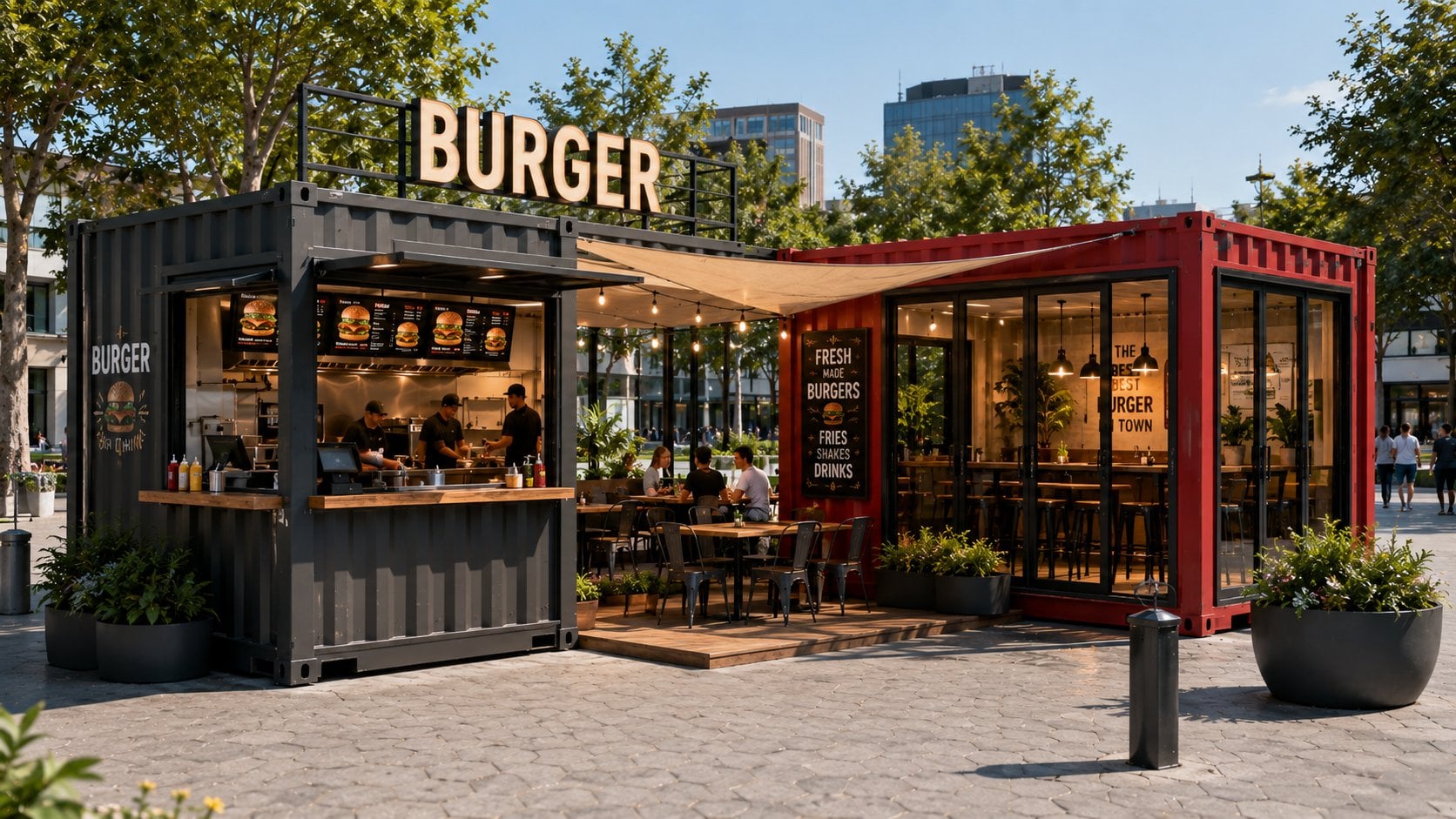
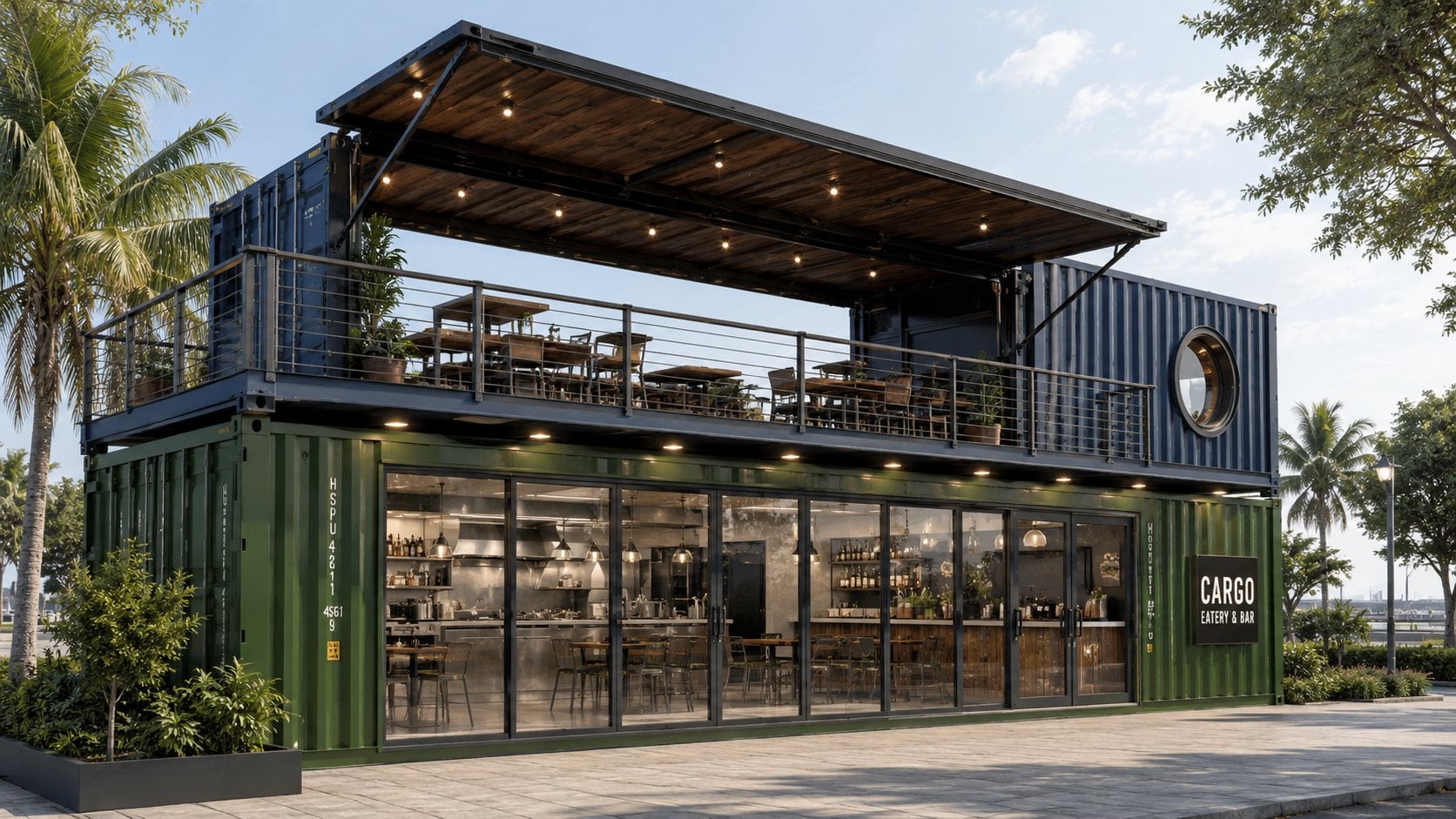
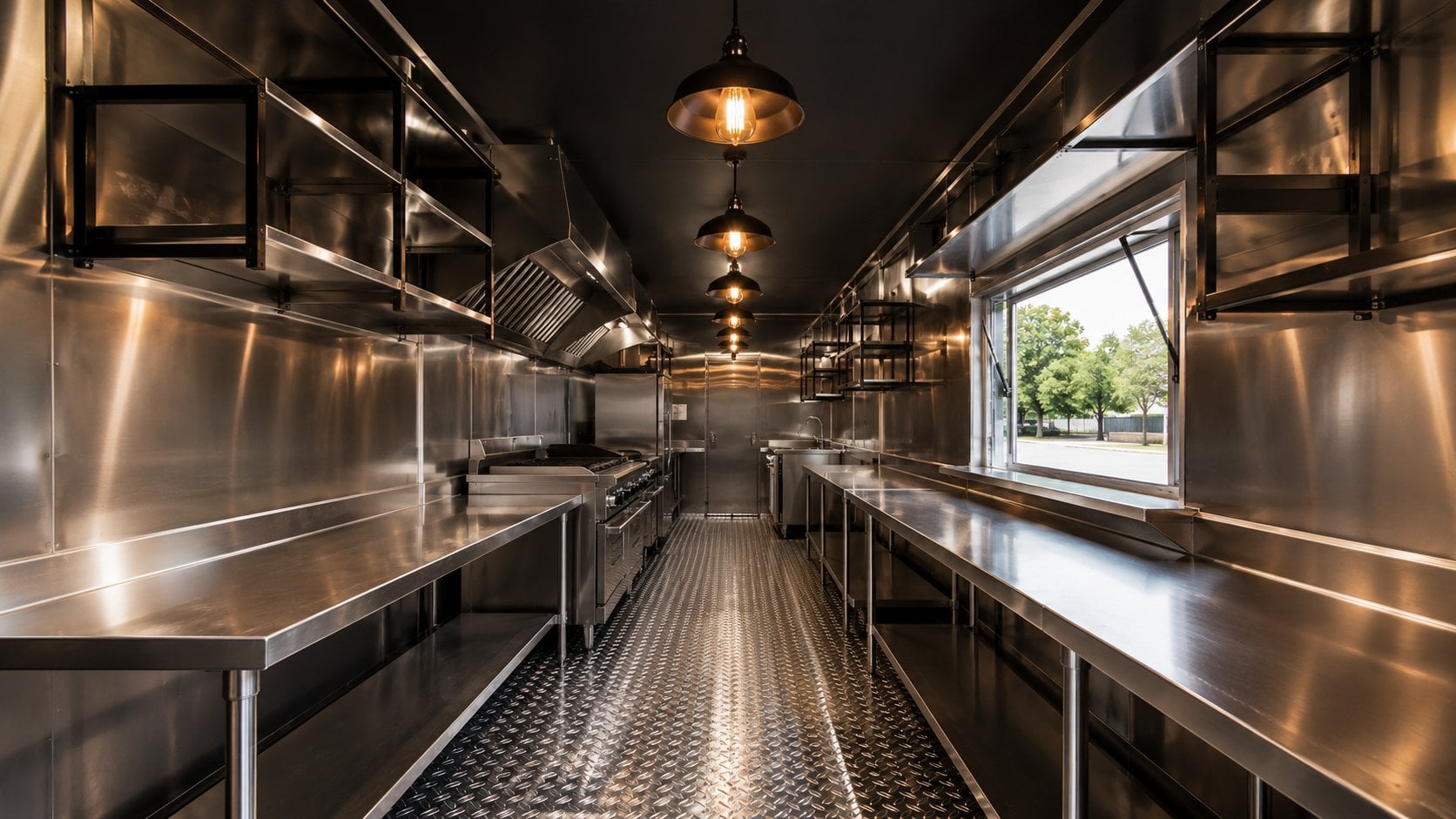
Container Kitchen ExteriorGRACE 20ft and 40ft container kitchens — pre-built at factory, delivered site-ready. Package A café and fast-food configuration shown.Fully Fitted InteriorComplete cooking line, refrigeration, exhaust and stainless worktables pre-installed and factory-tested before shipping — not fitted on site.
Sometimes the kitchen has to come to the project, not the other way around. A mining camp 200km from the nearest town. An offshore oil platform. An island resort with no construction trades available. A festival venue that exists for six weeks a year. A disaster-relief site where every day without a working kitchen means another day of inadequate field rations. Conventional construction takes months and depends on local trades — both of which are exactly what these projects don't have. The answer is the kitchen delivered as a finished product, pre-built and pre-tested at the factory, shipped to site, and connected to power, water and gas. Two to seven days later, it cooks.
This article walks through how GRACE delivers complete container kitchens as turnkey projects: our 6-phase process from site briefing through factory pre-build to on-site connection, the real container-kitchen installations we have delivered across 130+ countries — including our flagship project at OK Tedi, one of the world's largest copper and gold mines in Papua New Guinea, where GRACE delivered both the Tabubil town kitchen and the Mill Mess modular container kitchen — and what an operator can expect at each stage.
2006Founded
22,000㎡Manufacturing facility
3,000+Projects completed
130+Countries served
Key Takeaways
GRACE delivers container kitchens as fully-finished turnkey products — pre-built, pre-fitted, pre-tested at the factory, then connected on site within 2–7 days.
Container kitchens are the right answer wherever building conventional kitchens is impractical: mining camps, oil sites, island resorts, remote construction, disaster relief, temporary canteens.
Total project time is significantly shorter than conventional kitchen construction on the same site — factory build runs in parallel with site preparation.
20ft and 40ft modules combine for any capacity — single-container production kitchens, multi-container configurations for 1,000+ meals per day, dedicated refrigeration and service modules.
Flagship project: OK Tedi mining project, Papua New Guinea — one of the world's largest copper and gold mines, equipped with GRACE infrastructure across two coordinated kitchens (Tabubil town kitchen + Mill Mess modular container) and engineered to PNG fire-safety, electrical and HACCP standards.
Container kitchens solve a class of project that conventional kitchen construction cannot. Building a conventional kitchen in a mining camp requires local trades, regulated construction sequences, weather-tolerant timelines and reliable supply chains for materials — none of which exist on most remote sites. Building one for a festival or relief operation is impossible inside the project's window. Even where conventional construction is technically feasible, speed and risk often favour a pre-built kitchen delivered as a finished product. The factory takes the same construction work and does it in a controlled environment, in parallel with site preparation, in a fraction of the time, with the kitchen tested and verified to work before it ever ships.
What an operator needs is a contractor who can take the project from site briefing through factory build to operational handover — owning the structural integration, the equipment fit-out, the electrical and refrigeration systems, the testing, the shipping logistics and the on-site connection. This is what a turnkey container kitchen project is — and what GRACE has been delivering for over twenty years, to projects from boutique resorts to industrial-scale mining operations.
The GRACE 6-Phase Container Kitchen Project Process
Every container kitchen we build follows the same six phases. Sequence and discipline are how operational targets are actually hit — and how an operator knows, at every stage, exactly where the project stands.
PHASE 1
Consultation & Site Briefing
Typical duration: 5–10 days
The project starts with the site and the operation, not the container. We need to understand: the deployment location and climate, the target meal output (covers per day at launch and at peak), menu mix (hot meal canteen, snack and beverage, full hospitality), how the kitchen will receive supplies (truck, helicopter, marine vessel), what utilities are available on site (grid power, generator, water source, gas, drainage) and what isn't, and the access path from the nearest port to the site itself.
Meals-per-day target at launch and at full operation
Service mode: canteen / staff catering / hospitality / hybrid
Container configuration: single-container, multi-container, or modular expansion path
Output: a written site brief signed off before design starts
PHASE 2
Container Integration Design
Typical duration: 10–18 days
From the site brief, our engineering team designs the kitchen integrated into the container structure — equipment layout, structural reinforcement points, insulation, ventilation, exhaust, water and gas runs, electrical distribution, refrigeration mounting. For multi-container projects, the inter-container connections — passageways, shared utilities, hot/cold zone separation — are designed from the start. Every drawing accounts for shipping constraints (door clearance, rigging points, container CSC certification) and operational realities (cleaning access, maintenance reach, hood capture).
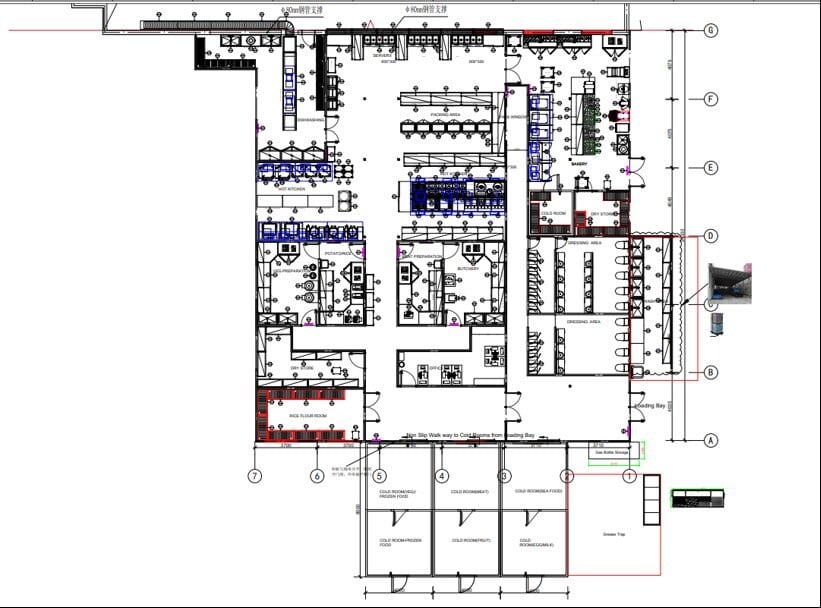
Tabubil kitchen, OK Tedi (PNG) — real project floor plan: hot kitchen, pastry, dishwashing, dressing area, six dedicated cold rooms (meat, seafood, fruit, vegetable, frozen food, dry storage), loading bay and grease trap, fully zoned and engineered for HACCP-grade workflow.
Equipment-loaded floor plan inside the container envelope
Structural, electrical, water, gas and exhaust routing designed in
Multi-container connection design where applicable
Tropical-rated refrigeration (43°C+ ambient) for hot-climate deployments
3D rendering of exterior and interior so the operator sees what arrives on site
Design delivered at no charge as part of the proposal
PHASE 3
Specification & Quotation
Typical duration: 5–10 days
With the integration design signed off, every item is specified — the container itself (new-build or repurposed marine container, CSC-certified for international shipping), cooking equipment matched to the menu and output target, refrigeration matched to climate, exhaust hood and fire suppression, electrical distribution panel, plumbing, gas and drainage interfaces — and a complete itemised quotation is issued.
Itemised quotation including container, equipment, systems and shipping interfaces
Container new-build or CSC-certified repurposed marine container per project
Equipment specifications matched to destination voltage, gas type and certifications
Fire suppression and exhaust per destination country safety standards
Output: a signed contract and design freeze before factory build
PHASE 4
Factory Build & Pre-Delivery Testing
Typical duration: 45–75 days
This is where container kitchens beat conventional construction. The entire kitchen is built inside the container at our 22,000㎡ Foshan facility — structural reinforcement, insulation, finished surfaces, equipment installation, electrical and plumbing connected, refrigeration commissioned, exhaust connected, fire suppression installed and certified, and the whole unit run-tested under power before packing. What arrives on site is not a kit; it is a tested operational kitchen waiting only for utility connection.
Complete in-factory build — structure, finishes, equipment, systems
Refrigeration commissioned and run-tested at the factory
Cooking equipment installed and connected before shipping
Exhaust hood and fire suppression installed and certified
Client factory visit or SGS/Intertek third-party inspection welcome
CE, SGS (#487222625_T), Intertek and ISO 9001 standards applied throughout
PHASE 5
Export Logistics
Typical duration: 14–35 days sea freight
A container kitchen ships as the container — directly on the standard shipping container infrastructure that moves freight worldwide. CSC certification means it can ship by sea, rail or truck to any destination port, then move by standard heavy-haulage to the final site. For remote inland or island sites, we coordinate with the logistics chain end-to-end, including last-mile transport on terrain that conventional construction materials simply cannot reach.
Ships as standard 20ft / 40ft container on global container shipping infrastructure
CSC certification for international sea, rail and road transport
Last-mile logistics coordinated for remote, island and mining-site delivery
FOB, CFR, CIF or DAP terms as preferred
Full export documentation including CO, packing list, B/L
PHASE 6
On-Site Connection, Commissioning & After-Sales
Typical duration: 2–7 days on site + ongoing
On site, what would have been weeks of conventional construction becomes days of utility connection. The container is positioned, levelled, then connected to site power, water, gas and drainage. The internal systems — already tested at the factory — are re-verified under site conditions; refrigeration is re-cycled, cooking equipment fired, exhaust drafted, fire suppression armed. Where local operators are unfamiliar with the equipment, our engineers train on site. After commissioning, warranty coverage and spare-parts supply continue across our 130+ country project base.
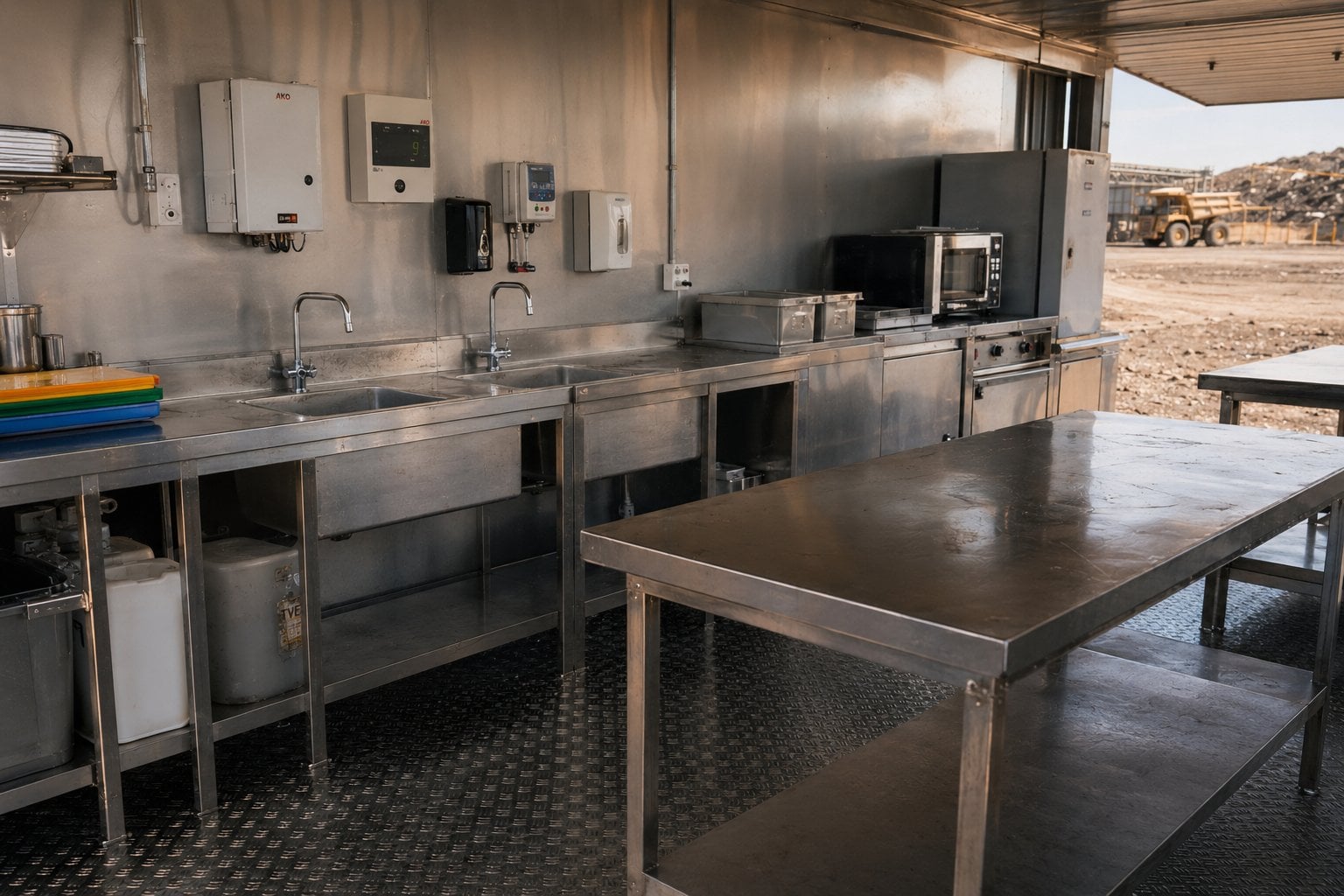
Container kitchen interior at a remote mining site — cooking line, ventilation, refrigeration and stainless prep surfaces all pre-installed at factory and operational within days of on-site connection.
Site positioning, levelling and utility connection — typically 2–7 days
Re-verification of refrigeration, cooking and exhaust under site conditions
Fire suppression armed and certified for the destination country
On-site operator training where required
Warranty, spare-parts supply and remote technical support across 130+ countries
Real Container Kitchen Projects We Have Delivered
The most reliable signal of whether a contractor can run this process is the projects already on record.
GRACE Package C mining-site container kitchen in operation — open-sided service configuration feeding a shift crew at a remote site. The same configuration deployed at OK Tedi serves hundreds of meals per shift in one of the world's most logistically demanding mine sites.
⭐ FLAGSHIP PROJECT
OK Tedi Mining Project — Papua New Guinea
One of the world's largest copper & gold mines · Two-site catering infrastructure · Tabubil town kitchen + Mill Mess modular container kitchen
The OK Tedi mine, in the remote Star Mountains of Papua New Guinea, is one of the world's largest copper and gold mines and the most significant economic operation in PNG. The catering infrastructure has to function reliably in one of the most logistically demanding sites on earth — far from any city, accessible only by air and river, in tropical climate with frequent heavy rainfall, on a 415V PNG electrical supply, and with limited local trades.
GRACE delivered two coordinated kitchen projects for OK Tedi: the Tabubil town kitchen, a permanent on-site commercial kitchen with full back-of-house production, dressing, dishwashing, bakery and six dedicated cold rooms; and Mill Mess, a modular container kitchen for the mine-area workforce mess hall, factory-built and shipped fully fitted with integrated dual-temperature cold rooms. Together they cover both the permanent town-side catering and the modular mine-side catering — engineered, manufactured and commissioned to the same project specification.
Inside the OK Tedi Project: The Engineering Behind the Flagship
What makes OK Tedi a flagship is not the contract size — it is the engineering discipline the project demanded. Tropical climate, remote logistics, 415V PNG electrical supply, mining-site fire-safety standards, and the modular constraint of doing some of it inside shipping containers. The points below are the real engineering factors GRACE controlled, project-side, on both the Tabubil town kitchen and the Mill Mess modular container kitchen.
PROJECT 1 of 2
Tabubil Kitchen — Permanent On-Site Build
Engineering factors GRACE managed for the Tabubil town kitchen at OK Tedi
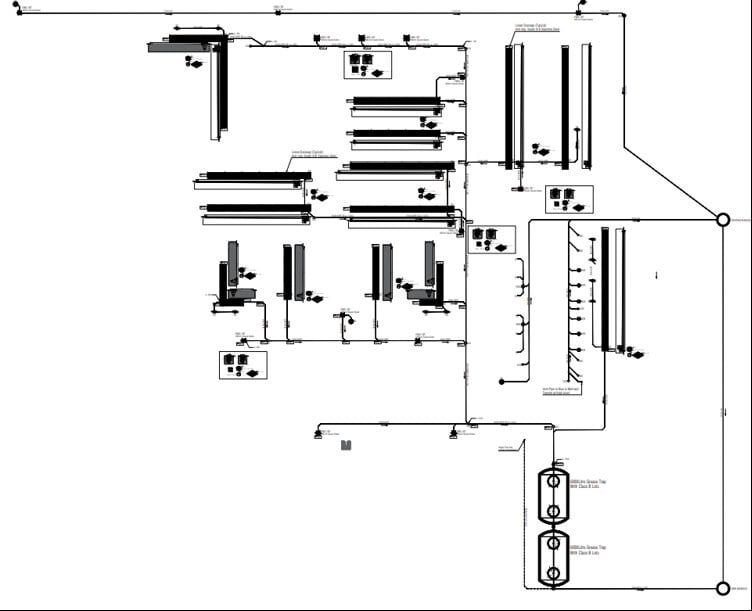
Tabubil drainage system — stainless steel linear floor drains at 1:60 grade flowing into 6,800L Class-B-lid grease traps × 2, sized to projected diners-per-service and PNG environmental discharge standards.
Equipment voltage and rating plates matched to PNG electrical standards — every appliance shipped with voltage, rating plate and power label specified for 415V three-phase / 240V single-phase PNG supply, so no re-labelling or on-site rework is required.
Fire-rated extraction: 400°C / 120-minute fan and grease-filter standard — extraction fans and grease filters certified to operate through a 400°C fire event for 120 minutes, meeting commercial kitchen fire-safety requirements applicable to mining-camp and remote-site catering operations.
Roof load engineering for hood and fan installation — structural load calculation for the canopy hood and roof-mounted extraction fans verified against the building's roof bearing capacity before installation begins.
Floor drainage gradient and direction — stainless steel linear floor drains routed and built at 1:60 grade, with flow direction designed so all kitchen-zone wash-down water reaches the grease trap without pooling.
Full coordinated drawings package — layout, drainage, electrical and gas-isometric drawings delivered as a single coordinated set, so site engineers and local authorities review the project from one document set, not five separate ones.
Grease trap sizing by meal count — grease trap volume calculated against projected diners-per-service; the Tabubil specification was 6,800L Class-B-lid grease traps × 2 in series for the full kitchen discharge load.
Total electrical load calculation — every appliance's power draw summed, balanced across three phases, and matched to the site's available electrical supply with appropriate distribution board sizing.
PROJECT 2 of 2
Mill Mess — Modular Container Kitchen
Engineering factors GRACE managed for the modular container kitchen at the mine site
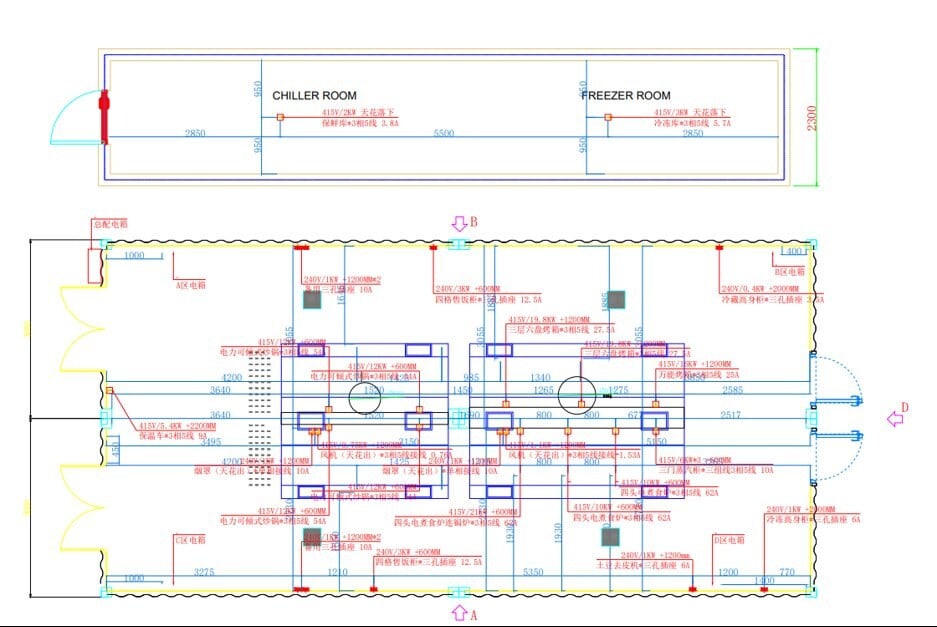
Mill Mess modular container kitchen — integrated dual-temperature cold rooms (chiller + freezer) shipped inside the container, with every appliance annotated to its 415V three-phase or 240V single-phase circuit and power rating. Real shop-floor drawing, not a sales mock-up.
Container roof penetration drawings for fan installation — exact opening positions, dimensions and reinforcement detail engineered before any cuts are made into the container roof, so the structural integrity of the shipping container is preserved.
Hood weight verified against container roof load capacity — canopy hood weight calculated against the container roof's structural bearing capacity; reinforcement specified where the load exceeds standard container limits.
Dual-temperature cold rooms integrated into the container — chiller room (+2~+4°C) and freezer room (-18°C) factory-installed inside the container, so the cold chain ships as one unit and arrives commissioned, not assembled from parts on site.
Equipment anchored to the container structure — every appliance bolted via fixing feet to the container floor and walls, designed to survive ocean transport, river-barge transfer and overland delivery to the mine site without movement.
Coordinated drawings for a sealed container environment — layout, drainage and electrical drawings designed for the container's routing constraints (ceiling clearance, single-point service entry, sealed envelope) — not adapted from open-kitchen drawings.
Electric-only specification for the mine fuel restriction — where the mine restricts gas use on safety grounds, the entire cooking line is specified as electric (induction ranges, electric combi ovens, electric tilting pans) to eliminate site fuel handling.
Total electrical load calculation for the container panel — every appliance summed and balanced across 415V three-phase and 240V single-phase circuits, with appropriate breaker sizing for the container's distribution board.
This level of engineering documentation is what separates a real turnkey project from an equipment list. On a remote-site project, the equipment is the easy part; the load calculations, fire ratings, structural integrations and coordinated drawing sets are what determine whether the kitchen actually works on day one. GRACE owns all of it.
Oil & Gas Site — Middle East
Remote field catering · Multi-container deployment
Container kitchen installation for an oil and gas operation in the Middle East, supplying daily field-worker catering at a remote site beyond conventional construction reach. Multi-container configuration with production, refrigeration and dining modules, engineered for high-ambient operation.
Island Resort — Pacific
Boutique island hospitality · Single-container production kitchen
A container production kitchen for a boutique island resort in the Pacific — a site where conventional kitchen construction was logistically impossible. The container shipped directly from factory to island, was positioned by crane, connected to site utilities, and was operational within days of arrival.
Construction Camp — Central Asia
Major infrastructure project · 500-worker daily catering
A construction-camp catering installation for a major infrastructure project in Central Asia, sized to 500-worker daily meal output. Containers shipped overland from China across the CIS region and connected on site — replacing months of conventional kitchen construction with weeks of factory build and days of site connection.
📄
Want the full container kitchen project case studies?
Completed container kitchen projects — including the OK Tedi mining project — each have a full project brochure with integration drawings, equipment specifications, factory build photos, deployment logistics and on-site connection records. We send these directly to qualified mining operators, hospitality developers, defence contractors and infrastructure project managers on request.
Email [email protected] with your site location and target meal output, and we will share the relevant case studies.
📦
Product Brochure
Container Kitchen Packages — A / B / C / D
Four ready-to-use standard configurations — Café & Fast Food · Restaurant & Steakhouse · Mining & Industrial Camp · Walk-in Chiller & Freezer. Includes reference projects, budget reference and contact details.
The six-phase process is only reliable because of what sits behind it. Five things define our capability on container kitchen projects:
Capability
What it means for your project
22,000㎡ in-house facility
Container structure, equipment, refrigeration, electrical and stainless work all built under one roof — one quality standard across the whole unit
13 product categories · 4,800+ SKUs
Every equipment need inside the container met without sub-contracting to second or third suppliers
Cold-chain depth · IceStorm brand
Refrigeration for tropical and remote-site projects engineered to operate reliably at 43°C+ ambient — essential for mining, oil and island deployments
Remote & difficult-site delivery record
Project record includes Papua New Guinea (OK Tedi mine), Middle East oil & gas, Pacific islands, Central Asia construction camps — sites others cannot reach
CE · SGS #487222625_T · Intertek · ISO 9001
Documented certification for international shipping, fire suppression, electrical and food-safety compliance required by mining, oil & gas and resort operators
This is also why GRACE delivers projects beyond container kitchens — hotel kitchens, central kitchens, bakery production lines, banquet operations and cold-chain installations through our IceStorm brand. Each project type follows the same 6-phase discipline. Detailed process guides for those project types are published as part of this series.
Frequently Asked Questions
What is a turnkey container kitchen project?
A complete commercial kitchen pre-built inside a 20ft or 40ft shipping container at the factory, then delivered to site and connected to power, water and gas — typically operational within 2–7 days of arrival. The operator signs one contract and receives a fully fitted, tested kitchen, not raw containers to be fitted on site.
Where do container kitchens make sense?
Mining camps, oil & gas sites, island resorts, remote construction projects, military bases, disaster relief, festival catering and temporary site canteens — wherever building a conventional kitchen is impractical, slow or impossible. They also work for permanent facilities where speed of deployment matters more than custom architecture.
How long does a GRACE container kitchen project take?
Factory build and testing runs 45–75 days, with the kitchen fully fitted and operationally tested before shipping. Sea freight is 14–35 days. On-site connection is typically 2–7 days. Total project time is significantly shorter than building a conventional kitchen from scratch on the same site.
Can container kitchens handle real catering volume?
Yes. GRACE container kitchens have been deployed for projects serving hundreds of meals per day, including the OK Tedi mining project in Papua New Guinea. Multi-container configurations — connected production, refrigeration and service modules — can scale to 1,000+ meals per day.
Can GRACE deliver to remote and difficult sites?
Yes. Project record includes Papua New Guinea (OK Tedi mine in the Star Mountains), Pacific islands, Central Asia construction camps, Middle East oil sites and remote African deployments. Container shipping infrastructure reaches anywhere standard freight reaches; last-mile logistics are coordinated end-to-end.
Are GRACE container kitchens engineered for tropical climates?
Yes. For Africa, the Middle East, tropical Asia and the Pacific, refrigeration is specified with tropical rating (43°C+ ambient) as default through our IceStorm cold-chain brand. Exhaust, ventilation and insulation are also matched to high-humidity, high-temperature operation.
Start a Container Kitchen Project with GRACE
Send us your site location, target meal output and deployment timeline. Phase 1 begins within 48 hours — and the integration design that comes out of Phase 2 is free.