
304 vs 201 Stainless Steel for Commercial Kitchen Equipment: What Buyers Should Ask
304 and 201 can both be used in commercial kitchen equipment, but the grade name alone does not establish suitability. Buyers should confirm the exact material, the parts made from it, and the conditions those parts will face. Neither “304 never rusts” nor “201 is always unsuitable” is a reliable purchasing rule. Compare documented materials and construction against the kitchen’s actual work.
What is the difference between 304 and 201?
Both are austenitic stainless steels. Type 304 belongs to the chromium–nickel family. In 200-series grades, manganese and nitrogen replace some of the nickel. That changes the alloy balance; it does not, by itself, define the quality of a finished table or cooker. Outokumpu’s explanation of austenitic grades describes these families and their properties.
Outokumpu describes its specified Core 201/4372 as having corrosion resistance close to 304/4301, with higher strength. That is evidence about a defined producer grade, not permission to treat every sheet sold simply as “201” as equivalent. Ask for the designation and supporting material document before comparing quotations.
A practical comparison for buyers
| Question | 304 | 201 | Buying decision |
|---|---|---|---|
| What material is offered? | Chromium–nickel austenitic grade. | Lower-nickel chromium–manganese austenitic grade. | Request the exact designation and producer documentation. |
| Will it suit the environment? | Widely used in food equipment; still needs an exposure review. | Assess the specified alloy and its documented application limits. | Describe water, food residues, chemicals, heat and wet contact. |
| Is the equipment strong enough? | The grade label does not specify the complete construction. | The grade label does not specify the complete construction. | Compare thickness, supports, joints and the intended load. |
| Does the label cover everything? | May identify only particular components. | May identify only particular components. | List the material of the top, bowl, cabinet, shelf and frame separately. |
Start with the kitchen environment
Identify what will touch the surface and for how long. A dry storage shelf and a sink holding salty water present different selection questions. Record cleaning products, dilution instructions, rinse practices, operating temperatures and places where liquid can collect. For coastal sites, include the surrounding exposure in the brief.
The SSINA design guidance hosted by worldstainless identifies environment, concentration and temperature as important material-selection variables. It describes 304 as useful across many food-processing applications, while noting limitations under some hot, acidic or chloride-rich conditions. For demanding exposure, request a supplier’s assessment of alternatives, rather than assuming either 304 or 201 is automatically adequate.
Some lower-nickel grades have their own documented applications. Aperam’s 201D technical sheet, for example, lists food-industry equipment among its applications and describes its particular alloy balance. This is a useful reminder to read the actual data sheet. It is not evidence that an unidentified 201 material has the same composition or performance.
Specify each component, not just the headline
A useful quotation states where a material specification applies. A worktop description does not identify the cabinet beneath it. Likewise, a sink bowl specification does not identify its legs, shelf, drain fittings or fasteners. Put these distinctions into the agreed equipment schedule so that buyers and suppliers compare the same scope.
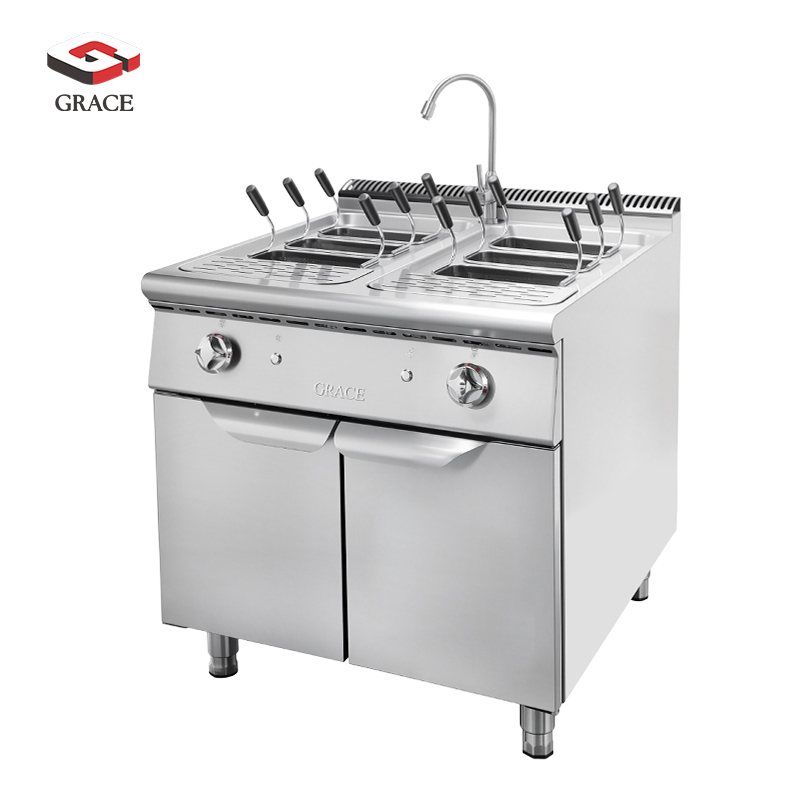
For a concrete GRACE example, the published GR-906 gas pasta cooker with cabinet page lists its countertop as SS304 with a thickness of 2.0 mm. This is a countertop statement for that model. It does not establish that its entire cabinet, every component, or the GRACE product range uses the same grade and thickness. Confirm the specification in the quotation for the unit being ordered.
When reviewing stainless steel fabrication options, add the surface finish, usable dimensions, support arrangement and cleaning access to the material description. Ask how corners and joints are finished, and inspect the areas beneath a top or around a bowl as carefully as the visible face.
Questions to put on your purchasing checklist
- Which exact grade is specified? Request its standard designation and an available material certificate or producer data sheet.
- Which parts use that grade? Ask for a component list, including surfaces, bowls, cabinets, shelves and frames.
- What does the thickness describe? Confirm the sheet being measured and the agreed tolerance, rather than judging a folded edge.
- What conditions were assumed? Provide food exposure, water conditions, cleaning products and the intended operating environment.
- What will be checked before shipment? Agree the document review, inspection points and any necessary material-verification method.
- How should the equipment be maintained? Obtain written cleaning instructions and clarify how a material discrepancy would be handled.
Frequently asked questions
Can 304 stainless steel rust?
Yes. Stainless steel resists corrosion under suitable conditions; it is not immune to every environment. The relevant questions include chemical exposure, temperature, deposits and maintenance. A 304 label is not a lifetime guarantee against staining or corrosion.
Does 201 automatically mean poor-quality kitchen equipment?
No. A clearly identified 201 grade may be suitable for an assessed application. Evaluate the supplier’s material evidence, construction and proposed use together. A low price or a polished appearance establishes neither suitability nor a defect.
Can a magnet distinguish 304 from 201?
A magnet is not a reliable grade certificate. Austenitic stainless can develop a magnetic response after forming or other processing. ASSDA’s technical guidance on magnetic effects explains why processing matters. If identification is important, agree an appropriate material test with a qualified provider.
Is the stainless grade enough to judge hygiene?
No. Material selection and the finished equipment’s cleanability need consideration together. worldstainless’s food-equipment guidance explains the importance of surfaces that can be cleaned and disinfected. Review joints, access and cleaning instructions alongside the intended food-contact use and relevant destination requirements.
Discuss the material requirements for your project
Send the equipment list, installation setting and material preferences to GRACE. Ask for the proposed grade and thickness by component, with any alternatives identified clearly. A specific, agreed description gives everyone a more useful basis for purchasing than a single “stainless steel” label.
Discuss Your Material Requirements