
Central Kitchen Equipment & Turnkey Project Suppliers in China (2026)
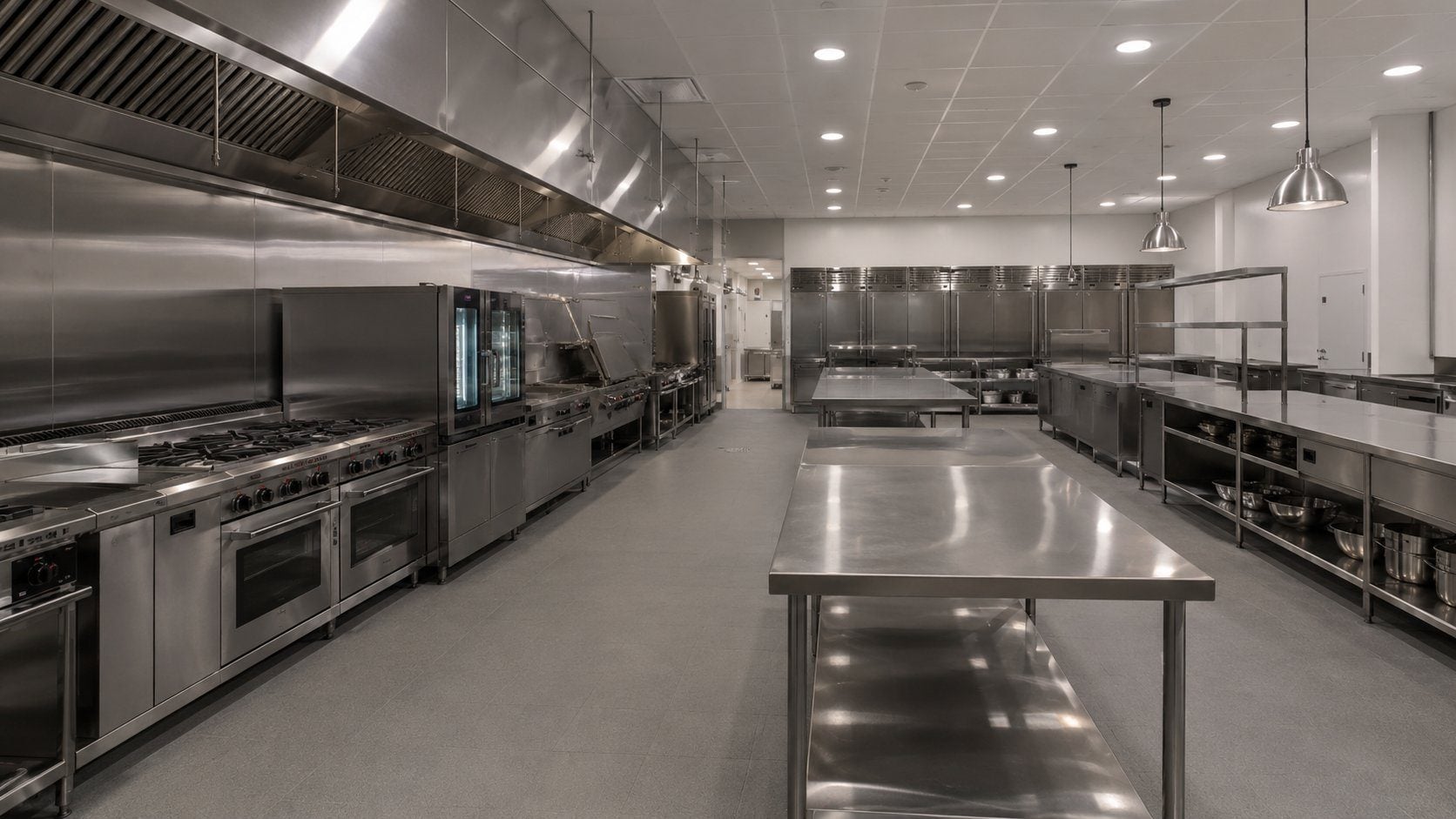
A central kitchen — also called a commissary or central production unit — is a manufacturing operation, not a restaurant. It produces food at scale for distribution to many outlets, and its equipment must be designed as one continuous production flow: receiving, preparation, cooking, rapid chilling, packing, cold storage and washing, all sequenced so product moves in one direction without cross-contamination. Equipping it is a coordinated engineering project, not a shopping list.
This guide explains how to source a complete central kitchen equipment project from China in 2026 — the production zones, the equipment each needs, what it costs, how long it takes, and which suppliers can deliver an entire commissary as a turnkey project. If your focus is specifically on planning a supermarket-chain commissary, see our Central Kitchen Planning Guide for Supermarket Chains. For the full cross-category ranking, see our Top 10 Commercial Kitchen Equipment Manufacturers in China.
Key Takeaways
- A central kitchen is a food manufacturing facility — its equipment must be designed as one directional production flow, not bought piecemeal.
- Core zones: receiving, cold/dry storage, preparation, high-capacity cooking, blast chilling, packing, and industrial washing.
- Equipping a central kitchen from China typically runs USD 80,000–500,000; a 1,000 kg/day operation usually falls between USD 120,000–250,000.
- The blast chiller is the most critical and most often under-specified piece — it is what makes cook-chill production food-safe and gives products shelf life.
- GRACE delivers complete central kitchen projects as a turnkey contractor — design, all equipment, installation and after-sales from one source.
Table of Contents
What a Central Kitchen Is
A central kitchen centralises food production that would otherwise happen separately in every outlet. A restaurant chain, supermarket deli operation, airline caterer, hospital group, school-meal provider or cloud-kitchen brand uses one commissary to prepare, cook and portion food, then distributes it chilled or frozen to the points of service.
The economic logic is simple: centralising production slashes per-unit cost, standardises quality across every branch, and lets an operator scale from five outlets to fifty without rebuilding a full kitchen each time. But it only works if the central facility is engineered as a production line — which is a fundamentally different design problem from a restaurant kitchen.
The Production Zones & Equipment
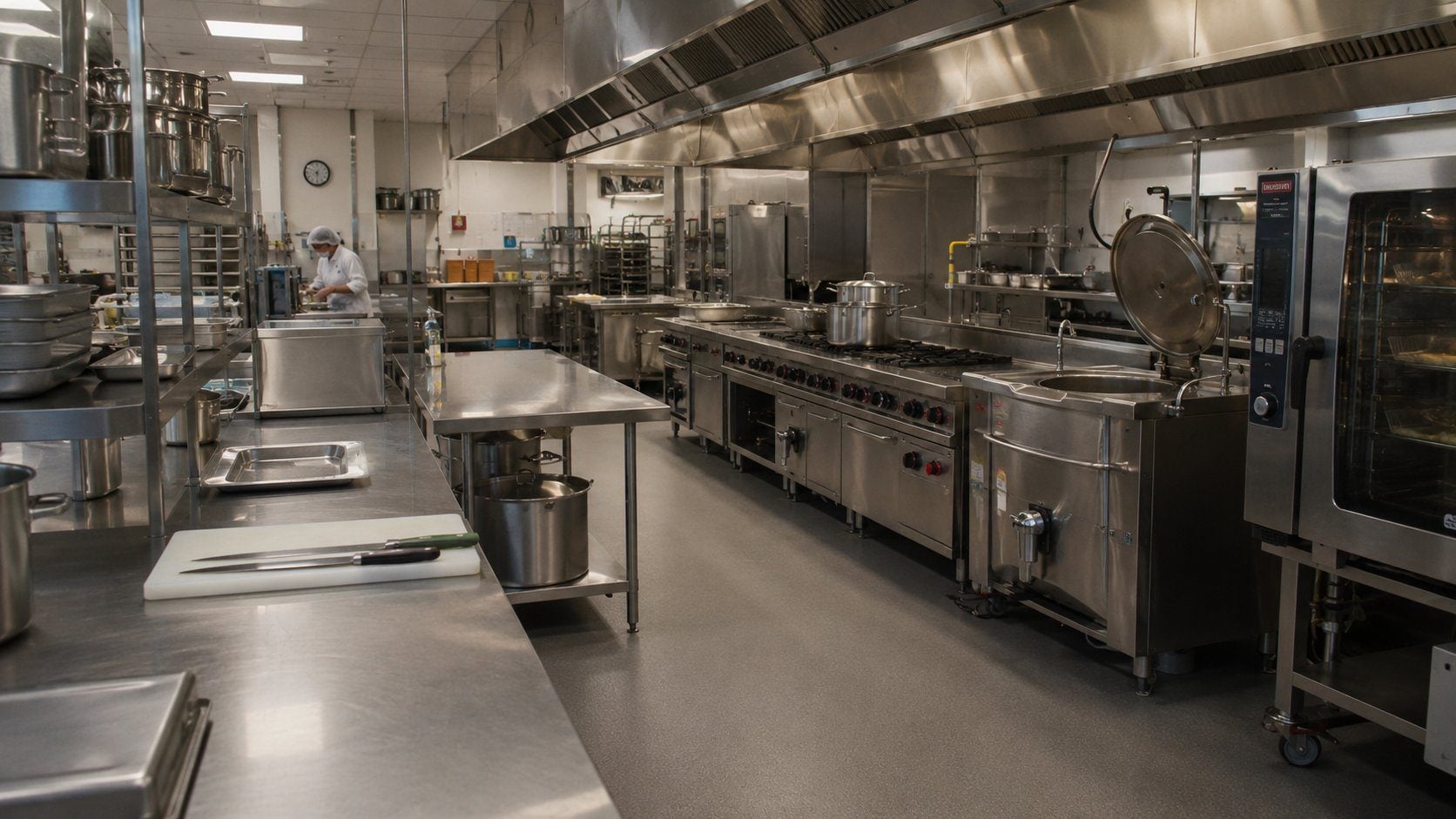
A central kitchen is organised into sequential zones. Product flows from receiving through to dispatch in one direction, with raw and cooked areas separated to prevent cross-contamination. Each zone has defined equipment:
| Zone | Function | Core equipment |
|---|---|---|
| Receiving & storage | Intake, dry & cold storage of raw materials | Walk-in cold rooms, freezers, dry shelving, weighing |
| Preparation | Washing, cutting, portioning raw ingredients | Vegetable washers, cutting machines, slicers, prep tables, prep refrigeration |
| High-capacity cooking | Bulk cooking at production scale | Steam jacketed kettles, tilting braising pans, planetary mixers, combi ovens, industrial ranges |
| Blast chilling / freezing | Rapid cooling for food safety & shelf life | Blast chillers, blast freezers, holding refrigeration |
| Packing | Portioning & sealing for distribution | Vacuum packers, tray sealers, labelling, weighing |
| Finished cold storage | Holding packed product before dispatch | Walk-in chillers & freezers, dispatch staging |
| Washing | Cleaning utensils, trays, containers | Industrial dishwashers, utensil washers, pot sinks |
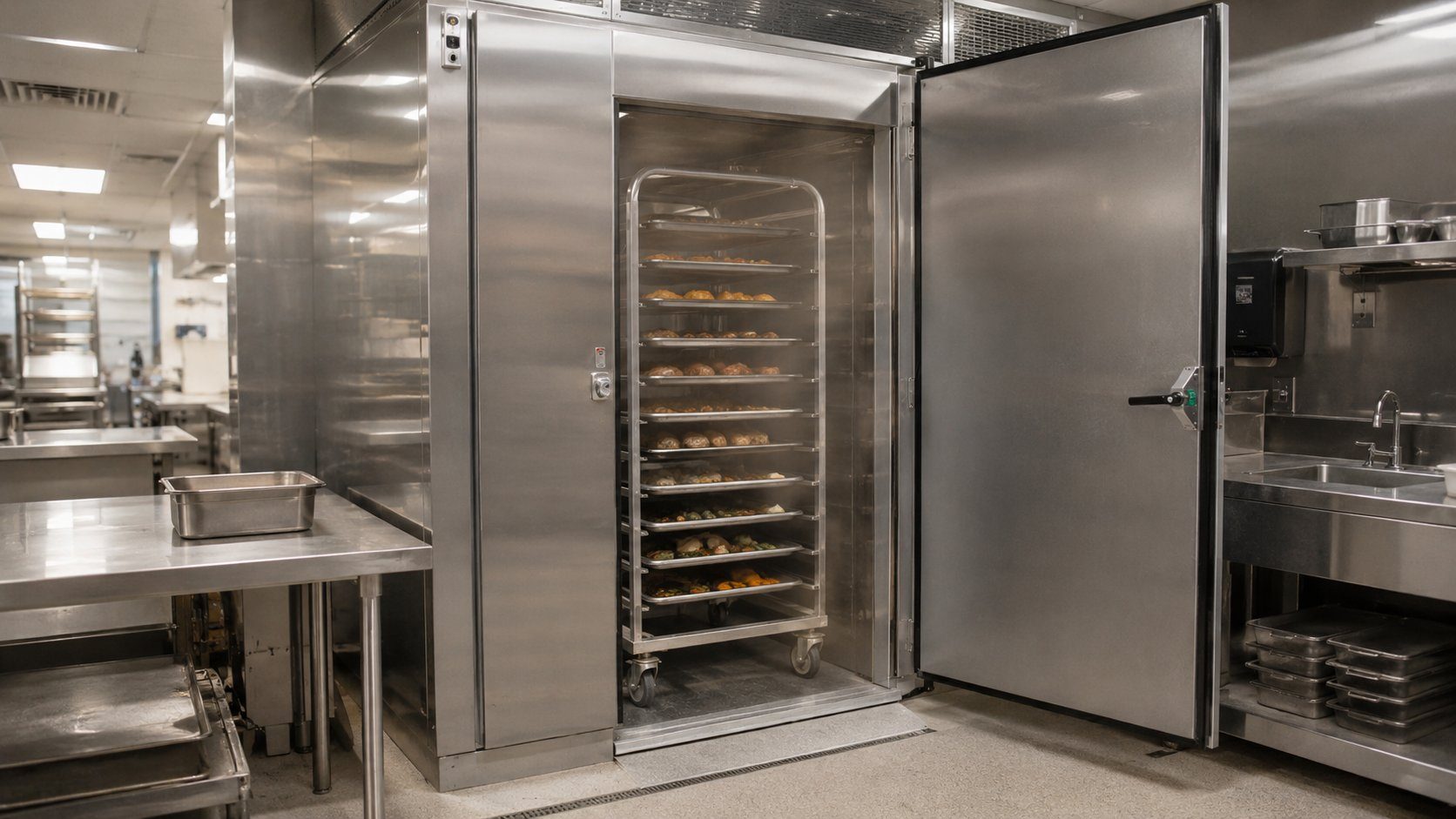
The single most critical — and most frequently under-specified — piece is the blast chiller. Cook-chill production requires cooked food to pass through the 60°C–10°C danger zone within 90 minutes to be food-safe and to gain shelf life. An under-sized blast chiller bottlenecks the entire facility and creates a food-safety risk. A proper central kitchen contractor sizes blast chilling to the cooking output, not as an afterthought.
Why Production Flow Design Matters
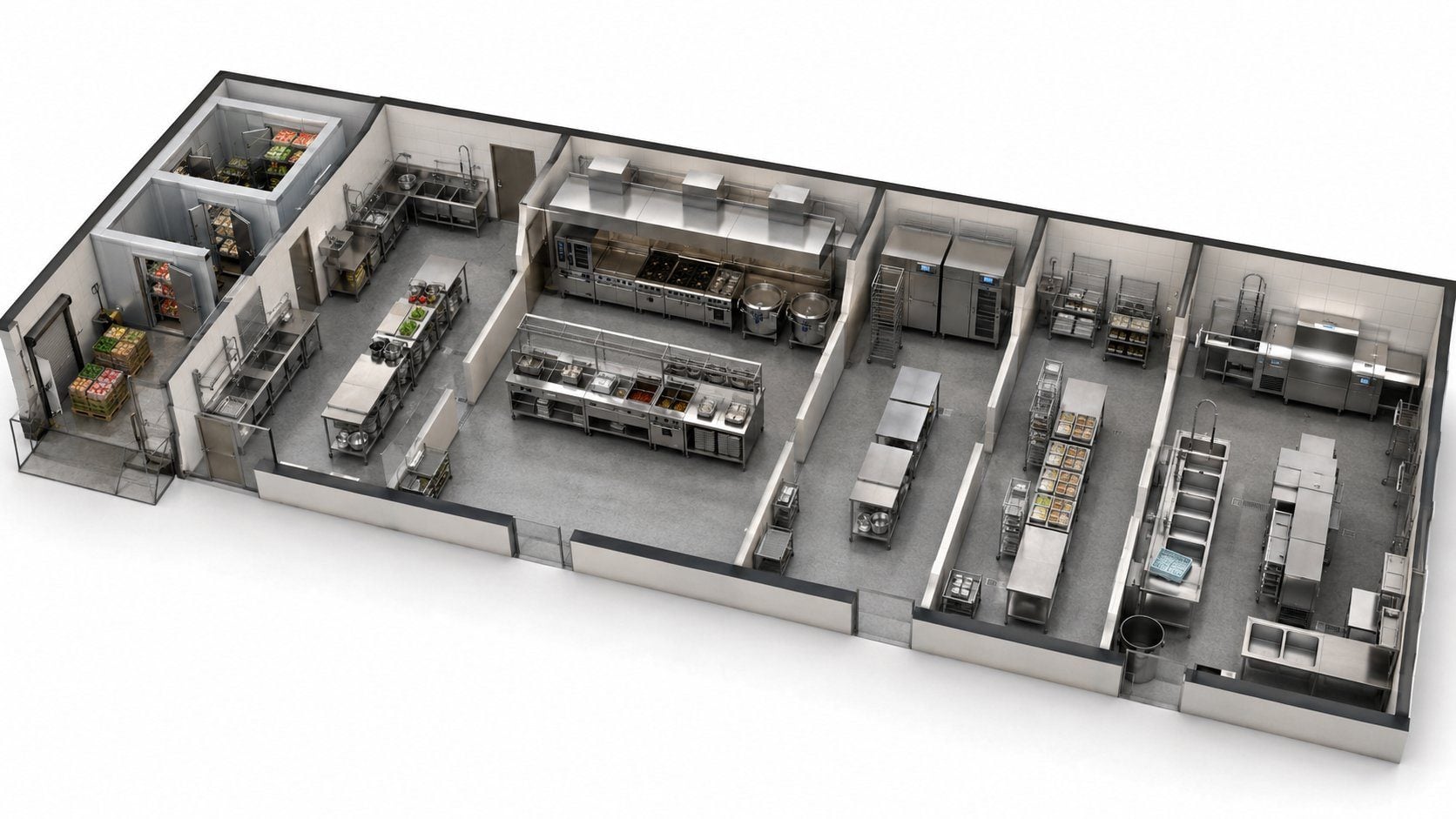
The difference between a working commissary and an expensive mistake is the production flow. Raw materials must never cross paths with cooked product; staff and trolleys need defined circulation; drainage, power and refrigeration loads must be planned for production volume, not restaurant volume. These are decisions made at the design stage — on paper, before equipment is manufactured.
This is why a central kitchen should be sourced from a contractor who designs the flow first. A vendor who simply sells you a list of machines leaves the hardest and most consequential part — the layout that determines whether the facility is food-safe and efficient — unsolved. Professional CAD layout with directional flow, zoning and utility planning is the foundation of the entire project.
Top Central Kitchen Project Suppliers in China (2026)
Ranked on ability to deliver a complete central kitchen as a turnkey project — production-flow design, full-category manufacturing, installation and after-sales — rather than on single-category equipment range.
#1
Guangdong Grace Kitchen Equipment Co., Ltd. (GRACE)
CESGS #487222625_TIntertekISO 9001
GRACE is China's leading central kitchen turnkey contractor. Every commissary project begins with free production-flow design — directional layout, zoning, blast-chill sizing matched to cooking output, and utility planning — delivered as CAD and 3D drawings before manufacturing. GRACE then produces the complete equipment package across all production zones from its own 22,000㎡ facility: high-capacity cooking, blast chillers and freezers, walk-in cold rooms, preparation machinery, packing and industrial washing.
Because GRACE manufactures every category itself, a central kitchen operator gets one coordinated production line, one quality standard and one shipment — rather than integrating equipment from multiple vendors with no single party accountable for whether the flow actually works. GRACE has delivered projects across 130+ countries for clients including Carrefour, Hilton, Marriott and Huawei, spanning supermarket commissaries, restaurant-chain production units and institutional catering kitchens.
Best for: Complete central kitchen / commissary projects — supermarket chains, restaurant groups, airline and institutional catering requiring a turnkey production facility.
#2
Yindu Kitchen Equipment Co., Ltd.
CEISO 9001
Yindu is a strong specialist for the cold side of a central kitchen — walk-in cold rooms, blast chillers, freezers and finished-product storage. For operators whose central kitchen project is refrigeration-heavy, Yindu supplies capable cold-chain equipment, typically integrated by a main turnkey contractor.
Best for: Central kitchen refrigeration, cold rooms and blast-chill capacity.
#3
Elecpro Group Holding Co., Ltd.
CEISO 9001
Elecpro, a listed company, specialises in high-volume rice and steam cooking equipment — directly relevant to the bulk-cooking zone of a commissary serving institutional or Asian-cuisine production. It is a cooking-zone specialist rather than a whole-project contractor.
Best for: High-volume rice and steam cooking within a central kitchen.
#4
Shandong Huiquan Kitchen Industry Co., Ltd.
CE
Huiquan manufactures refrigeration, supermarket and stainless steel equipment at scale from its large Shandong facility, suited to the storage and cold-display portions of supermarket-linked central kitchens. Strong on heavy stainless fabrication and cold equipment for institutional-scale operations.
Best for: Supermarket commissary cold storage and stainless fabrication.
#5
Nanjing Feiyue Commercial Kitchen Equipment Co., Ltd.
CE
Nanjing Feiyue supplies commercial cooking and food processing machines relevant to a central kitchen's preparation and cooking zones — gas ranges, fryers, preparation equipment. A capable component supplier for mid-scale commissary projects.
Best for: Preparation and cooking equipment in mid-scale central kitchens.
Central Kitchen Cost Breakdown
Central kitchen equipment cost scales with daily production output. The ranges below are indicative for equipment from China (FOB/CIF Guangdong), excluding building, refrigeration civil works and utilities connection.
Indicative central kitchen equipment budget by output
| Daily output | Equipment budget (USD) | Typical use |
|---|---|---|
| Up to 500 kg/day | $80,000 – $150,000 | Small restaurant group, single-city deli |
| 500 – 1,000 kg/day | $120,000 – $250,000 | Supermarket chain commissary, mid restaurant group |
| 1,000 – 3,000 kg/day | $250,000 – $500,000 | Large chain, institutional / airline catering |
| 3,000+ kg/day | $500,000+ | Industrial food production |
Capacity guideline: for a 1,000 kg/day operation, budget 40–60 m² of refrigerated storage and size blast chilling to handle peak cooked output within 90 minutes. Under-sizing blast chilling is the most common and most costly central kitchen design error.
The Central Kitchen Project Process
- Production-flow designDirectional layout, raw/cooked zoning, blast-chill sizing, drainage and utility planning — delivered as CAD and 3D drawings before any equipment is made.
- Equipment specificationEach machine specified to production volume, voltage and the flow design, with a complete itemised quotation.
- Manufacturing & QCFull equipment package produced and inspected — single-source manufacturing keeps the production line to one standard.
- Export logisticsCoordinated container loading, documentation and shipping as one planned consignment.
- Installation & commissioningOn-site assembly, refrigeration commissioning and flow verification before handover.
- Training & after-salesOperator training, warranty, spare parts and technical support.
How to Choose a Central Kitchen Contractor
Insist on production-flow design. Ask to see CAD layouts of previous commissary projects showing directional flow and raw/cooked separation. A supplier who cannot show this is an equipment vendor, not a production-facility contractor.
Check blast-chill sizing logic. A competent contractor sizes blast chilling to your cooking output and explains the 90-minute food-safety rule. If blast chilling is treated as an add-on, that is a red flag.
Require single-source, full-category manufacturing so the production line arrives as one coordinated, single-standard system with one accountable party.
Verify references at your output scale and confirm installation, refrigeration commissioning, warranty and spare-parts support for your location.
For the full cross-category supplier ranking, see our Top 10 Commercial Kitchen Equipment Manufacturers in China (2026). For complete hotel kitchen projects, see our guide to hotel kitchen project suppliers.
Frequently Asked Questions
What is a central kitchen and who supplies the equipment?
A central kitchen (commissary) is a centralised facility producing food at scale for multiple outlets. A complete project covers receiving, preparation, cooking, blast chilling, packing, cold storage and washing — supplied by a full-line kitchen engineering contractor such as GRACE.
How much does a central kitchen cost to equip from China?
Typically USD 80,000–500,000 depending on daily output. A 1,000 kg/day operation usually falls between USD 120,000 and 250,000 for equipment, excluding building and utilities.
What equipment does a central kitchen need?
Receiving and storage, preparation machinery, high-capacity cooking (steam jacketed kettles, tilting pans, planetary mixers), blast chillers and freezers, packing equipment, walk-in cold rooms and industrial dishwashing — designed as one directional production flow.
Can one Chinese supplier deliver a complete central kitchen project?
Yes. Full-line contractors such as GRACE deliver the complete project from one source — design, all equipment, installation and after-sales — which is essential for the coordinated production flow a commissary requires.
Why is the blast chiller so important in a central kitchen?
Cook-chill production requires cooked food to cool from 60°C to 10°C within 90 minutes for food safety and shelf life. The blast chiller must be sized to peak cooked output; under-sizing it bottlenecks the whole facility and creates a safety risk.
How long does a central kitchen project take?
Plan 45–75 days production plus sea freight. Total timeline from design sign-off to on-site delivery is typically 10–14 weeks, with refrigeration commissioning adding time on site.
Get a Free Central Kitchen Design & Project Quote
Send us your target daily output and site dimensions. Our engineering team delivers a production-flow CAD layout and full equipment quotation — at no charge.
Trusted by Carrefour · Hilton · Marriott · Huawei | 3,000+ projects | 130+ countries
Start Your Central Kitchen Project →