Banquet & Buffet Kitchen Equipment Project Suppliers in China (2026)
A banquet operation is two connected systems: a back-of-house banquet kitchen that cooks for hundreds of guests at once, and a front-of-house buffet line that holds and presents that food safely and attractively. The hard part is the link between them — cooking 300 covers to be ready at the same moment, holding it at safe temperature, and replenishing the buffet without quality loss. That is a flow-design and equipment problem, which is why a banquet kitchen is a project, not a shopping list.
This guide explains how to equip a complete banquet and buffet kitchen project from China in 2026 — the production side, the service line, the cook-chill link between them, what it costs, and which suppliers can deliver the whole thing as one coordinated project. For a detailed equipment-and-price breakdown of buffet display units specifically, see our Hotel Buffet Equipment Setup Guide. For the full cross-category ranking, see our Top 10 Commercial Kitchen Equipment Manufacturers in China.
Key Takeaways
- A banquet operation = back-of-house production kitchen + front-of-house buffet service line, connected by cook-chill and holding.
- The defining challenge is volume timing: getting hundreds of covers ready simultaneously and holding them safely until service.
- Core production: tilting pans, steam kettles, combi ovens, blast chillers; core service: hot counters, cold displays, live-cooking stations.
- A banquet and buffet project from China typically runs USD 40,000–300,000 depending on guest capacity.
- GRACE supplies the complete banquet project — production, cook-chill and buffet service line — designed as one flow from kitchen to guest.
Table of Contents
The Two Halves of a Banquet Operation
Whether a hotel ballroom, a wedding venue, a conference centre or a catering company, a banquet operation always splits into two zones with very different equipment needs.
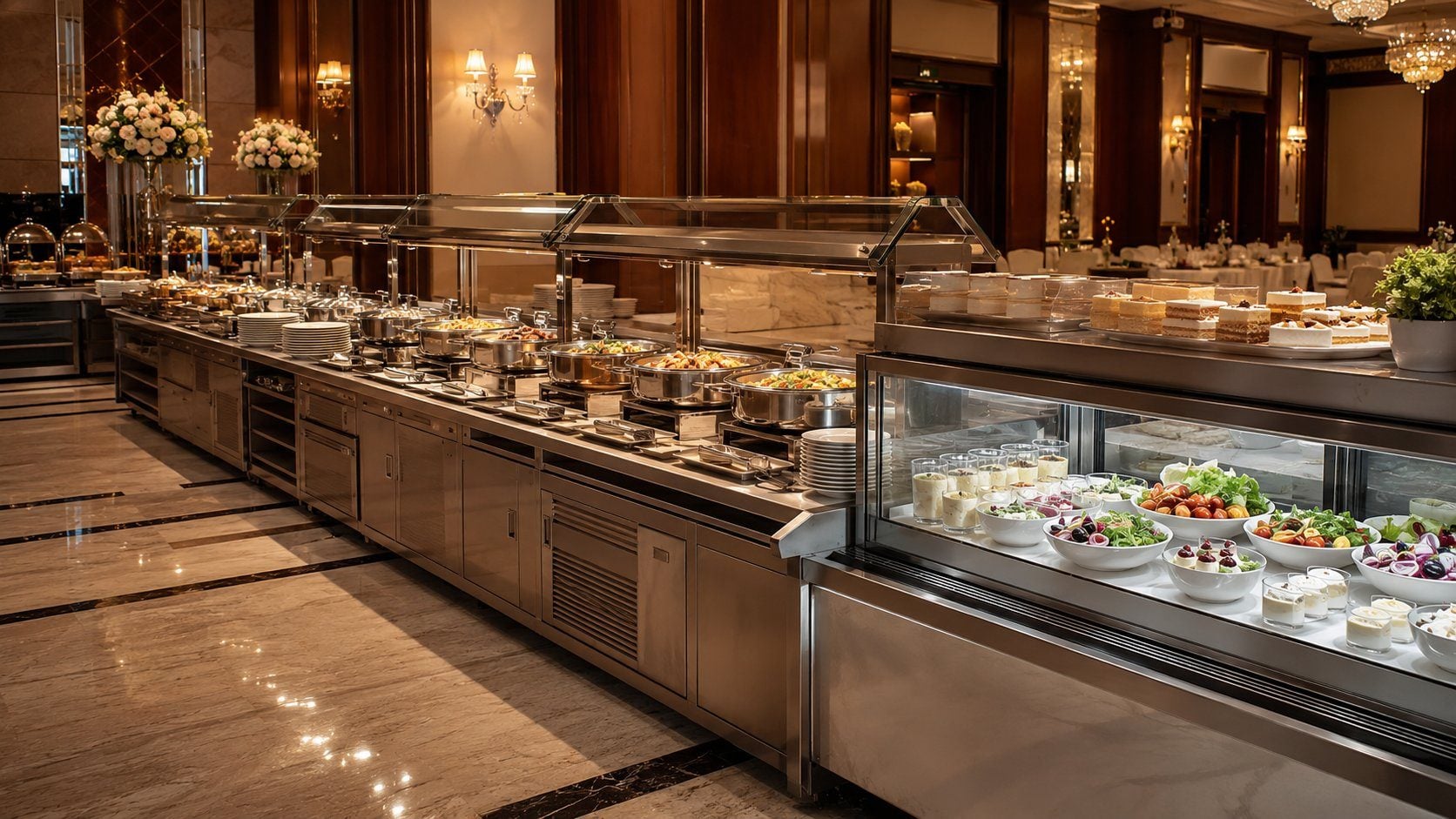
The production kitchen (back of house) must cook large volumes in batches that finish together. Its equipment is about capacity and speed: large tilting braising pans, steam jacketed kettles, multi-rack combi ovens, and crucially blast chillers to cook ahead and chill safely. The buffet service line (front of house) is about presentation and safe holding: hot counters that keep food at 65°C+, refrigerated cold displays at under 5°C, live-cooking stations, and beverage service.
Sourced separately, these two halves rarely connect well — the kitchen cooks more than the buffet can hold, or the buffet is sized for a guest count the kitchen cannot produce on time. A banquet project contractor designs both to the same event capacity.
The Banquet Production Kitchen
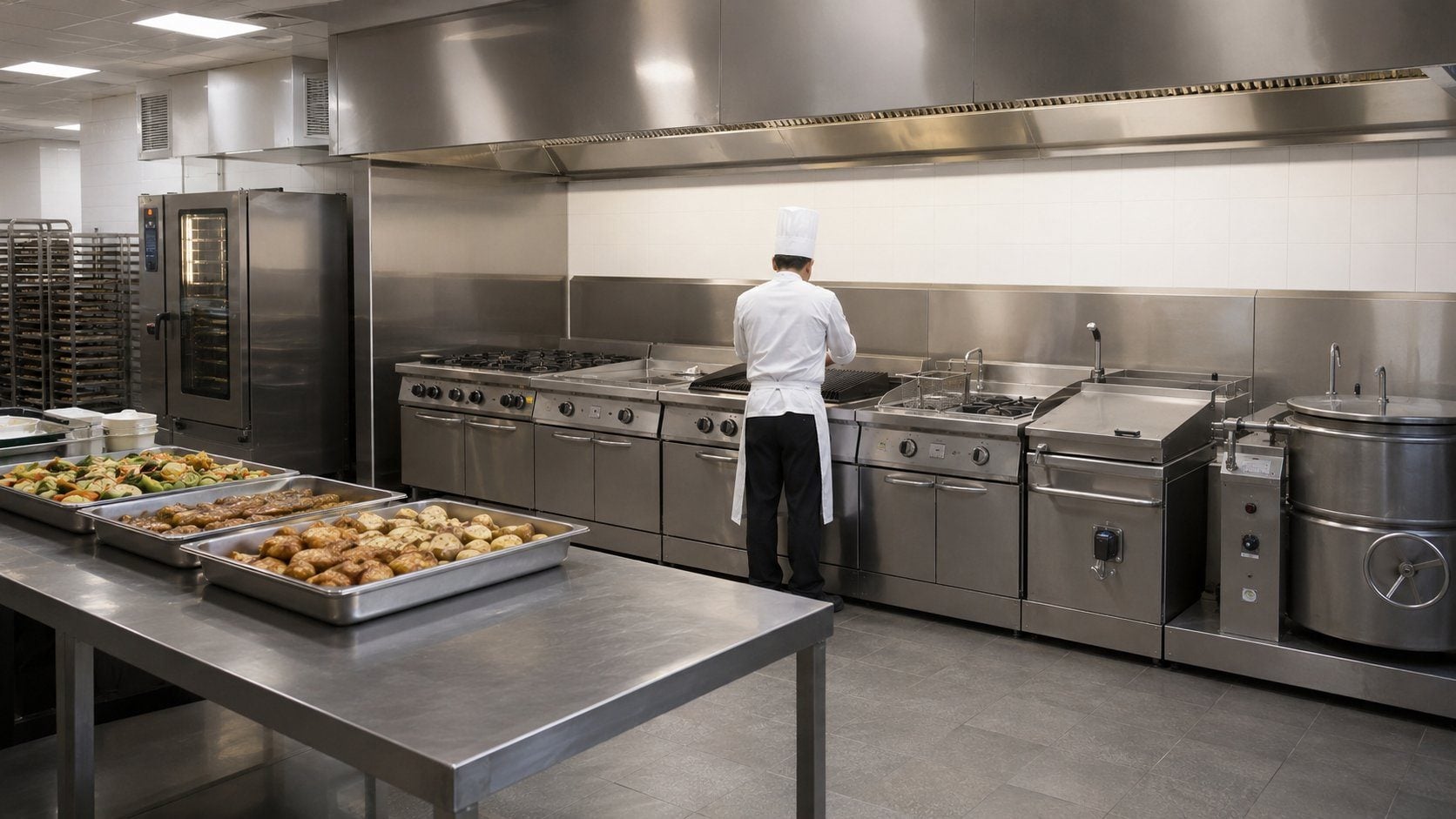
The production kitchen is built for volume output in timed batches. Key equipment:
| Equipment | Role in banquet production |
|---|---|
| Tilting braising pans | Cook large batches of stews, sauces, rice, and sautéed dishes; tilt to empty quickly between batches |
| Steam jacketed kettles | High-volume soups, sauces, stocks with even, gentle heat |
| Combi ovens (multi-rack) | Roast, steam and bake large quantities with precise control; the workhorse of banquet cooking |
| Blast chillers | Cook-ahead: rapidly chill cooked food for safe holding and timed regeneration |
| Holding cabinets | Keep regenerated food at serving temperature until plating or buffet transfer |
| Mobile transport | Heated/refrigerated trolleys move food from kitchen to ballroom safely |
The combi oven and blast chiller together enable the cook-chill method that makes large banquets possible — without them, a kitchen must cook everything à la minute, which simply cannot scale to 300 simultaneous covers.
The Buffet Service Line
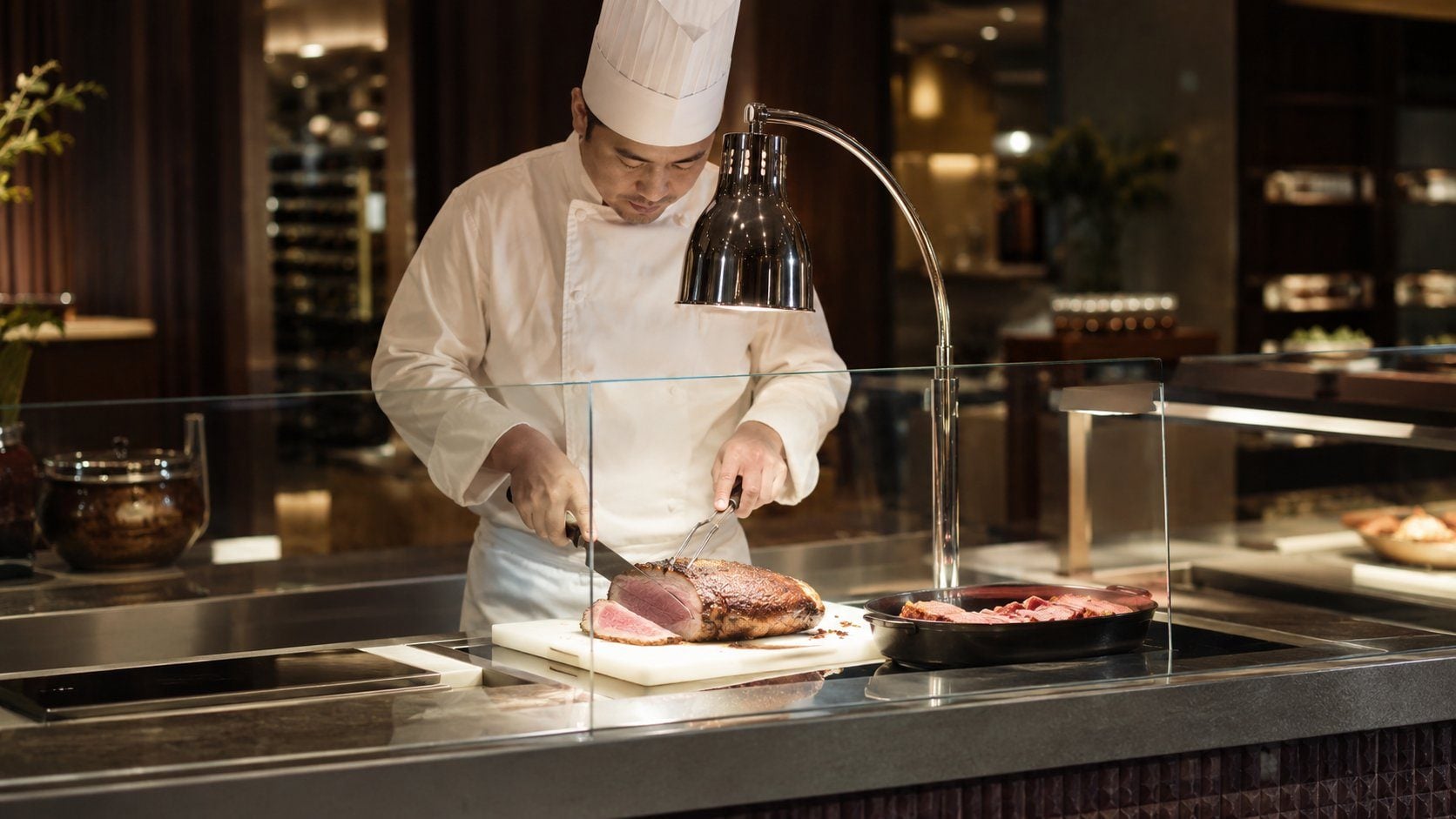
The service line is where the operation meets the guest. It must hold food safely for hours while looking abundant and fresh. Core equipment includes hot counters and bain-maries (holding at 65–85°C), refrigerated cold displays and salad bars (under 5°C), live-cooking and carving stations, soup wells, and beverage dispensers. For full specifications and price ranges on these display units, our dedicated buffet equipment guide covers each category in detail.
The design priority here is the food-safety temperature gap: hot food above 63°C, cold food below 5°C, and nothing left in the 5–63°C danger zone. A properly engineered buffet line maintains these temperatures across a multi-hour service without drying food out — which depends on correct counter type, wattage and humidity control matched to the menu.
Cook-Chill: The Critical Link
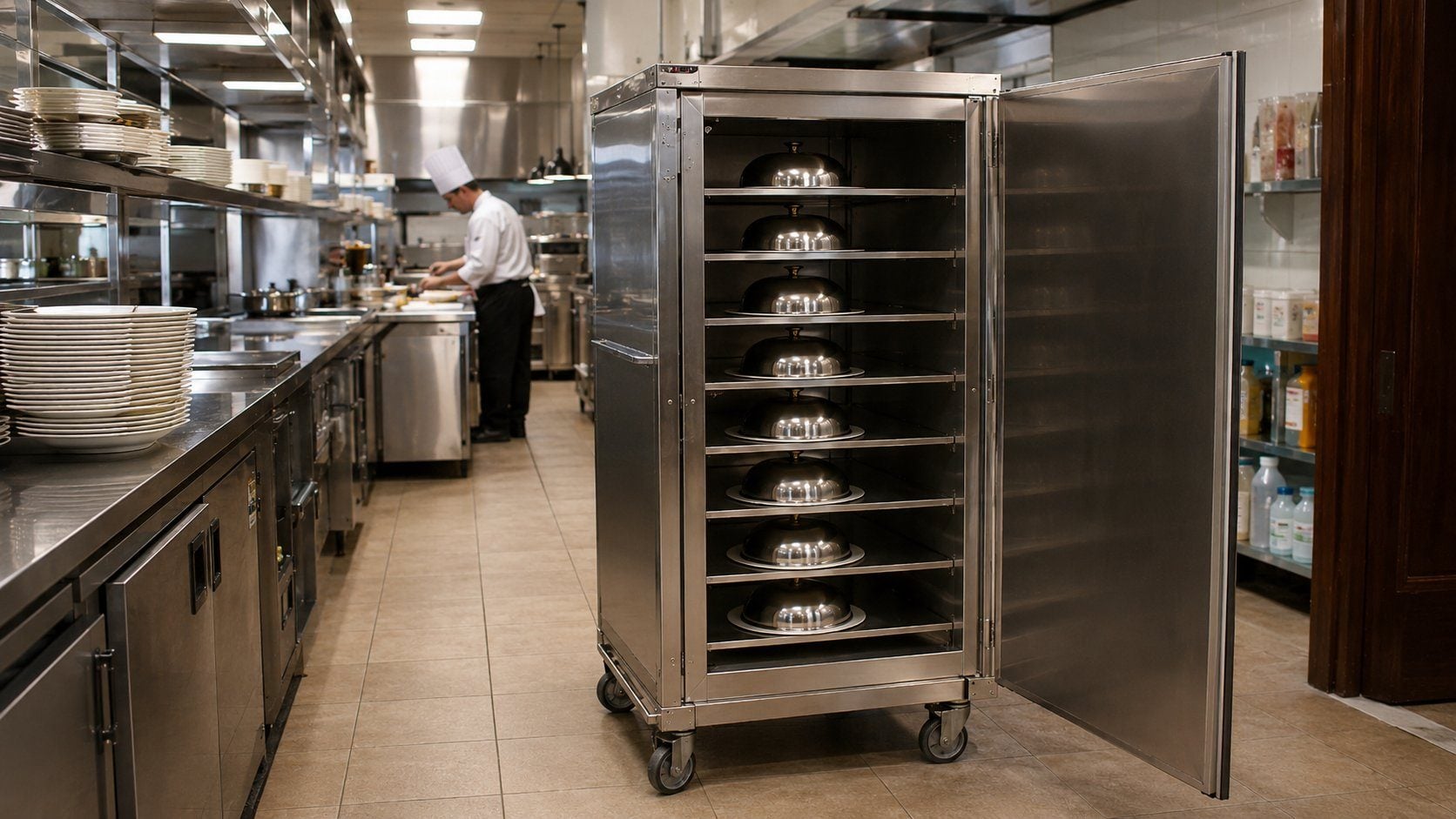
The single feature that separates a professional banquet operation from an amateur one is cook-chill. Food is cooked in advance, blast-chilled through the danger zone within 90 minutes, held cold, then regenerated to serving temperature just before the event. This is what lets a kitchen serve 500 guests a hot, consistent meal at 7:00 pm sharp.
The blast chiller must be sized to the production kitchen's peak cooked output — under-size it and the whole banquet operation bottlenecks at the most safety-critical point. This cook-chill backbone is shared with central kitchens; for high-volume multi-event operations, our central kitchen equipment guide covers production scaling in depth.
Top Banquet & Buffet Kitchen Suppliers in China (2026)
Ranked on ability to deliver a complete banquet operation — production kitchen, cook-chill link and buffet service line — as one coordinated project, rather than on single-category range.
#1
Guangdong Grace Kitchen Equipment Co., Ltd. (GRACE)
CESGS #487222625_TIntertekISO 9001
GRACE delivers complete banquet and buffet operations as one coordinated project. Because it manufactures both the production side (tilting pans, steam kettles, combi ovens, blast chillers, holding cabinets) and the buffet service line (hot counters, cold displays, live-cooking stations) in its own 22,000㎡ facility, GRACE sizes the kitchen, the cook-chill link and the buffet to one event capacity — so the kitchen can produce exactly what the buffet holds, on time.
Every banquet project starts with a free flow-design layout linking back-of-house production to front-of-house service, delivered as CAD and 3D drawings. GRACE has equipped banquet and buffet operations for hotels and venues across 130+ countries, including Hilton and Marriott properties, with buffet setups from 50-room boutique hotels to 500-room resort complexes.
Best for: Complete banquet and buffet projects — hotel ballrooms, wedding and conference venues, catering companies needing production plus service designed as one flow.
#2
Yindu Kitchen Equipment Co., Ltd.
CEISO 9001
Yindu is a capable specialist for the buffet service line — cold displays, salad bars, buffet stations, food warmers and refrigeration. For the front-of-house side of a banquet operation it offers strong display equipment, typically integrated with a main production-kitchen contractor.
Best for: Buffet display, cold counters and banquet refrigeration.
#3
Foshan Semikron Electronic Technology Co., Ltd.
CE
Semikron's induction equipment suits live-cooking stations and induction buffet systems, increasingly popular for their clean, flameless front-of-house presentation. A component specialist for the induction portions of a buffet line.
Best for: Induction live-cooking and flameless buffet stations.
#4
Elecpro Group Holding Co., Ltd.
CEISO 9001
Elecpro's rice and steam cooking equipment supports high-volume banquet production, particularly for Asian-cuisine banquets serving rice and steamed dishes at scale. A cooking-zone specialist rather than a whole-project contractor.
Best for: High-volume rice and steam cooking for large banquets.
#5
Foshan Nanhai Flamemax Catering Equipment Co., Ltd.
CEISO 9001SGSTÜV
Flamemax supplies cooking and snack equipment relevant to banquet production lines — ranges, fryers, griddles and ovens. A capable supplier for the cooking core of a banquet kitchen, with full-flow design typically handled by a project contractor.
Best for: Banquet cooking-line equipment.
Banquet Kitchen Cost Breakdown
Cost scales with guest capacity and the split between production and service equipment. Ranges below are indicative for equipment from China (FOB/CIF Guangdong), excluding building and utilities.
Indicative banquet & buffet equipment budget
| Banquet capacity | Equipment budget (USD) | Scope |
|---|---|---|
| Up to 150 guests | $40,000 – $70,000 | Small venue / boutique hotel |
| 200 – 300 guests | $60,000 – $120,000 | Mid hotel ballroom / wedding venue |
| 300 – 500 guests | $100,000 – $200,000 | Large hotel / conference centre |
| 500+ guests / multi-hall | $200,000 – $300,000+ | Resort / convention venue |
Split guideline: roughly 60% production kitchen (cooking + cook-chill), 40% buffet service line. Under-investing in blast chilling on the production side is the most common banquet design error — it caps how many covers can be served safely at one sitting.
How to Choose a Banquet Kitchen Supplier
Confirm they design both halves to one capacity. Ask the supplier to size the production kitchen and buffet line to the same guest count. A supplier quoting only buffet counters, or only cooking equipment, is solving half the problem.
Check the cook-chill logic. A competent banquet contractor sizes blast chilling to peak cooked output and explains the 90-minute rule. If cook-chill is missing from the design, the operation cannot scale safely.
Require single-source manufacturing of both production and service equipment, so the flow from kitchen to guest is one coordinated, single-standard system.
Verify references at your event scale and confirm installation, commissioning and after-sales for your location.
For the full cross-category ranking, see our Top 10 Commercial Kitchen Equipment Manufacturers in China (2026). For complete hotel projects that include banquet kitchens, see our hotel kitchen project guide.
Frequently Asked Questions
What is the difference between a banquet kitchen and a buffet line?
The banquet kitchen is the back-of-house production area that cooks large volumes for events; the buffet line is the front-of-house service area that displays and holds food for guests. A complete banquet project covers both, plus the cook-chill and holding that connect them.
How much does a banquet and buffet kitchen cost from China?
Typically USD 40,000–300,000 depending on guest capacity. A 200–300 guest banquet setup usually falls between USD 60,000 and 120,000 for production plus buffet service equipment.
What equipment does a banquet kitchen need?
High-capacity cooking (tilting pans, steam kettles, combi ovens), blast chillers for cook-chill, holding cabinets and bain-maries, mobile heated/refrigerated transport, and a buffet line of hot counters, cold displays and live-cooking stations.
Can one Chinese supplier deliver a complete banquet kitchen project?
Yes. Full-line contractors such as GRACE supply the complete project from one source — production cooking, blast chilling, holding and the buffet service line — designed as one flow from kitchen to guest.
Why is cook-chill important for banquets?
Cook-chill lets a kitchen cook in advance, chill safely, and regenerate just before service — the only practical way to serve hundreds of guests a hot, consistent meal simultaneously. It depends on blast chillers sized to the kitchen's cooked output.
How long does a banquet kitchen project take from China?
Plan 40–60 days production plus sea freight. Total timeline from design sign-off to on-site delivery is typically 9–13 weeks depending on scale.
Get a Free Banquet & Buffet Kitchen Design & Quote
Tell us your event capacity and venue layout. Our engineering team designs a production-to-service flow layout and full equipment quotation — at no charge.
3,000+ projects · 130+ countries · CE / SGS / Intertek certified
Start Your Banquet Project →